Friday, July 31, 2009

Fine Art vs. Commercial Photography

from Max:
Hi Kirk,
I would like to say thanks for your dedication to fine photographs. I share your appreciation of architecture. I also like the way you've managed to combine your commercial photography preference with your artistic aspirations and vision.
I suppose it's a common struggle. Your site makes it all seem like one.
Thanks Max. "Seeing it as one" was a long journey. I "grew up" artistically in an environment that disdained commercial photography at the renowned University of New Mexico Photography Department of the early 70's. This was during the rein of legends such as Van Deuron Coke and Beumont Newhall. Commercial photography was somehow tainted. Some years after graduation, I got into commercial architectural photography because I had a family to support and I was not accomplishing that strictly doing art photography and showing in galleries. Mentally it was not a happy marriage. I considered art my passion and the other what I did to support my passion. That doesn't mean I approached architectural photography with a lack of sincerity. Everything worth doing deserves serious attention, but commercial photography was, in my mind, definitely a second class citizen.

I defined the distinction this way. My art was illustrating my own ideas while the commercial photography was illustrating my clients ideas, but over the years that commercial point of view didn't hold water. Clients were hiring me to see into their designs. They were asking me to interpret their art. Many of the best designers I worked for didn't even do a walk through with me-sending me out to "see what I came up with". They saw me as an artist interpreting their art (that isn't to say that there is not a documentary aspect to AP, because there definitely is. You have to show the building). Many of these same architects are aavid collectors of my b&w work too.

In 2003 New Mexico magazine approached me about doing a retrospective book of my work, which became Shelter from the Storm: The Photographs of Kirk Gittings. I suggested a collection of my B&W, but they wanted it all. It was inseparable from their POV. I could not figure out how this would work organizationally or visually. I tried many times to come up with a workable draft, but I couldn't see it and finally turned the project over to their designers. My conceptual separation of the work was a barrier, but not for them. This experience really made me re-evaluate how I see my commercial work. It is more seamless for me now as a result of that project. I learned allot from that experience. Is there really a fundamental difference where a commission comes from, whether from a commercial client, an arts program or my own internal quest? What about being invited to participate in a group exhibit with a theme? Here is an example from a show where 20 photographers were asked to photograph the same model. Model Rose Bryant photographed at the ruined 17th century church at Quarai (Canon 5D, 24 T/S).


The experience led me to (or back to really, I had played with this some years ago) an interest in photographing figures in architecture and landscape, and led to a recent arts commission to photograph figures in landscape around Albuquerque. I don't find client requirements to be barriers to creativity, but instead stimulus to creativity.

Tuesday, July 28, 2009

Stitching programs for files from Tilt/Shift lenses.


I do allot of stitching these days for clients, usually a half dozen+ on every shoot. An effective stitching program is a must. I have stated before that I prefer Photoshop CS4 Photomerge over programs like Autopano Pro or PT Gui for flat stitched architectural images and the images below will illustrate why. Above are jpegs of the original raw files, Canon 5DM2, Canon 24T/S. The method was to simply level the camera-shift up and expose and shift down and expose. NOTE, the camera must be on manual exposure and the white balance set (4000 K on this) so that the exposure and white balance does not change automatically between exposures (I only use manual exposure normally for architecture anyway and expose based on the histogram). Below are the renderings of the images in Photoshop Photomerge and Autopano Pro. AutoPano Pro with its "best" projection mode (Planar in this case). It introduces allot of pincussioning that requires additional time in PS to correct.

This file is straight from the raw files in bridge via the PS Photomerge script. Photoshop Photomerge preserves much better the straight lines of the original files,


I find Autopano Pro to be superior for large multi-tiled landscape stitches. It seems superior at blending edges in skies and finding control points in clouds etc. But for my daily architecture bread and butter with Tilt/Shift lenses? Give me Photoshop CS4 Photomerge.

I discovered this problem with architecture in Autopano Pro this week because my PS Photomerge could not align any two images to save its life. With deadlines to meet, I was panicking. So I tried Autopano Pro and PT Gui again. Neither performed as well as simple PS Photomerge. It turns out that my problem in PS was a corrupted Preferences file and as soon as I erased that (the program will recreate it) the stitch program in PS ran fine. People tell me that it is a good idea to save a clean copy of your preferences file and replace the existing one at the first sign of trouble in PS. Where this is located depends on your operating system and PS version. So you will have to investigate this online. It is a fairly well known issue apparently.

For an alternative take on AutopanoPro see Jack Flesher's post on LL

The Kira Sowanick, AIA, Residence, Albuquerque, NM.

Sunday, July 26, 2009

Sorry All

I have been absolutely buried with work and have had no time for the blog. I will get back with peoples comments and emails after the end of the month probably. There are three design competition deadlines at the end of the month-my yearly bread and butter. Thanks for your patience.

Thursday, July 9, 2009

Abstraction in Architectural Photography: some thoughts.

"Between documentation and interpretation? How much of each is necessary or desired?"

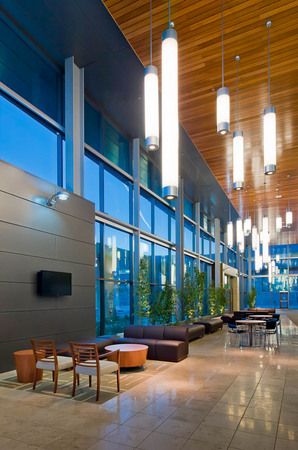
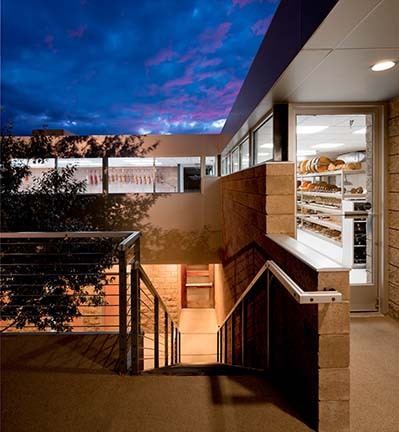
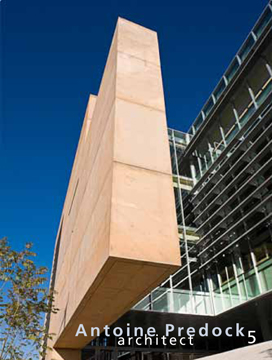
The answer for me, when the client is an architect, both. I am paid for both my eye and technical expertise. All photography requires interpretation just from the basic activity of framing an image, making a visual selection, but for some images it goes far beyond the process of selection. Over the course of an entire shoot, I must deliver images that both accurately depict the volumes, masses, setting, facades etc. and I must deliver images that interpret the feel of the design. It is in attempting to interpret the feel of the design where I am most aesthetically free. Here are a few examples that I did recently for a project. I'm never sure that the client will appreciate some of my more abstract interpretations, but usually my more creative clients appreciate my more creative images. Project, the Aperture Center, Mesa del Sol, New Mexico, Antoine Predock Architect.


Some of my favorite images of architecture are extreme abstractions that don't illustrate the physicality of a structure but speak to how design feels. Oftentimes these images fall on deaf ears (blind eyes?) and move no one but myself. But my more creative clients appreciate them. Here are examples from the Aperture Center shoot (above) designed by Antoine Predock FAIA with Jon Anderson Architects. Below are images I "encountered" while waiting for the light to get better!

Markets, Marketing and Fees: some thoughts.

Hey Kirk,
I want to compliment you on your blog. It's very informative and entertaining. I am an editorial and commercial photographer based in the Midwest. I have shot quit a bit of architecture in the last year for a few editorial clients. I find it very rewarding and am looking into shooting more architecture. I am wondering if you would be willing to share a little bit about your business model? My clients in the past have all been either magazines or advertising agencies. I am wondering who I should start marketing for architecture work. I'm also wondering how most people are charging? Day rates, project rates, usage?
Any info you can share would be greatly appreciated.


Thanks for the kind words. This is a big topic and I will add to it over the next few days so check back in. Who do you market architectural photography too? Who needs it the most? Architects, builders and "shelter" magazines. My largest volume clients are magazines, then architects and finally builders (and occasionally ad agencies). Part of that order is choice. I find builders to want the most pedestrian images and want bid photography, so they are my lowest priority (not always for sure, but generally speaking). Magazines have the most varied projects, which is stimulating, but generally don't pay great (not always though). Magazine work is your best advertising, so the low fees notwithstanding, magazines have their silver lining. Having studied art at the university level, architects and I speak the same visual language. I understand their needs the best and they value creativity. Hence, they the most
challenging and pay well.

My original strategy 30 years ago was to build a clientele amongst the less demanding builders as I built my portfolio, equipment and expertise. I then used that base for leverage to gain more lucrative and visually sophisticated design and magazine clients. For instance when shooting an important building for a contractor I would call the architect and ask if they need some photography too or want to share in the shoot. This strayegy worked so well that Iwould do it again if I had to start over again.

Variety is important from a economic stability point of view. When one market like residential may be down big commercial buildings may be stable or advertising in magazines may be booming. Right now residential is in the dumps but commercial is holding its own. That may switch next year as residential climbs out of the hole and commercial, which has a much longer lead time, starts to slow down. With residential seeing the light, magazine advertising (which pays for editorial) may boom as clients start to position themselves for the end of the recession.

Variety is also important in terms of keeping the creative juices flowing. A large office building is a very different challenge than a residence and I find those different challenges very stimulating.

There is no single fee strategy that works in all these markets. A national manufacturer will expect to pay far more than your neighborhood contractor. Day rates are still very common out this way, but even for me those vary tremendously depending on the size of the client and usage required. Fees for small local clients would make your skills suspect for large clients from major metropolitan areas. You need to know what is happening in both and position yourself based on your expertise and competition.

Without going into personal details, for a regular architecture documentation shoot, I have a shooting fee/day rate (which varies greatly depending on client), digital capture and processing fees (per image, multiplied for stitches, this is aimed at paying me a reasonable hourly rate for all the computer time), assistant fees, travel fees (if required), multiple copyright user surcharge (like say the architect and contractor want to split the shoot-it runs about half the shooting fee per additional client) and miscellaneous charges. These days we do approx. 30-40 images a day when documenting architecture, far more than we ever did with film (largely because digital is far more forgiving in mixed light situations so we can work faster). Art directed shoots for say a magazine will produce far fewer images.

Before the recession I was able to charge pretty much what I wanted without oftentimes even being asked for a proposal or estimate from established clients, but that has changed drastically. Recently I have even initiated significant fee reductions with some key magazine clients that are having trouble. Why? My business is largely built on long term relationships, some 30 years old now. We have gone through the highs and lows together and I want them to know I have not gotten so established that I'm inflexible and that we are still in this together. My general rule of thumb when the economy is growing? If you are established with clients that don't need to be educated about the value of AP? You should be having to do a hard sell about a third of the time to justify your charges. That way you are maintaining your base but always pushing the fee boundaries of your clients expectations. When no one is complaining about your charges-time to raise prices. We will get back there again, but if we are lucky it will be in two years.

New Mexico has not been hit as hard as many states and municipalities. A recent newspaper article indicated that house sales here were rebounding much faster than the national average and that stimulus money was already interring public sector construction in "shovel ready" projects. I feel for all you in some of the worst hit areas. I have a successful AP friend in the Midwest that is working at Hobby Lobby. Really tough. But I admire his flexibility. Do what you have to do.

A painter friend has an interesting recession strategy. With art you can't really back off prices without devaluing the purchases of previous clients. He raised his prices 20% and then told his galleries to offer a recession discount of up to 20%! It seems to be working for him.


More thoughts to come. I am buried with work so the strategies must be working.

Saturday, June 27, 2009

Book Review: Craig Childs' House of Rain


Craig Childs luminous 2007 book "House of Rain", about the Anasazi ruins and landscape of the Southwest, is a recent favorite of mine. I have savored this reading experience, reading it in small bites over a course of months. It is not about architecture per se or photography at all, but for me it sets the stage for much of my personal photography, like a quite church for prayer-reminding me of where I have roamed and where I wish to go. In prose that oftentimes resonates like poetry, Childs' vivid experiences, walking the ancient Anasazi trails of the Southwest, remind me of the many miles I have lugged a 4x5 to remote ruins in hopes of finding the fine light. It also reminds me of my successes and failures in that quest and of the richness of the experience regardless. But Childs' is a wanderer of biblical proportions seeking the promised land of his inquiry across the desert Southwest (for example Childs walked the Great North Road out of Chaco Canyon all the way to the ruins in Aztec NM. That's lmost 50 miles across the desert! I feel like I have walked many miles of various Chaco roads, but pathetically I doubt it adds up to less than 15 miles in total).

Slightly on the fringe (or leading edge?) of Southwestern archeology like Steve Lekson (The Chaco Meridian), Childs presents some fresh and controversial ideas about large scale migrations of the Anasazi and their descendants from New Mexico to Utah, south into Arizona and finally into Mexico. It is a sweeping tale on a continental scale, well researched and investigated and told in a lively experiential style,

Childs is one of those naturalist writers, like the late Loren Eiseley, whose sense of place transports me in space and time. His descriptions of regions like Comb Ridge Utah make me simply want to load film, jump in my car and roam. I have not been so moved photographically by a book in in a very long time.

Don't buy this book if you are looking for locations of great sites. They are only described in the vaguest of terms. But if you have spent much of your life, as I have, stalking these haunted places. This book memorably captures the spirit of that quest.

See: HOUSE OF RAIN

In addition I can recommend his "The Secret Life of Water". Together both books are a visionary tour de force about the SW landscape.

Thursday, June 25, 2009

Flourescent Fill Light?

From a question on the LargeFormat Forum about using 6500K fluorescents for interior fill on a cabin shoot with Fuji 50 film.

The Fuji 50 transparencies will come out very blue green. Nor will the flourescent fill lights be bright enough if you are trying to balance interior light and daylight, such as an interior balanced with the exterior through the windows (unless it is at twilight).

Additionally, The eye sees flourescents differently than film. Photographic daylight is 5500K. So if they are correctly represented, they will be cool to the tune of 900k. They will also be green on film which the eye does not see. How much? Depends on the light, but will probably require somewhere between 15-50 magenta to correct.

The best way, if the room fixtures are flourescents is to use the same bulbs in banks for fill. Then balance the film to all the bulbs.

What to use? For film I would never actually use flourescents at all, as all the bulbs are different and require testing to get the balance right. I own and used for 30 years a color temperature meter, but it was not super accurate for flourescents with transparency film. Based on experience I could make an educated guess, but testing was the only way to get it right. Personally I would use halogens with Rosco blue filters to bring them to daylight. By the way, I would not use Velvia 50. I would use a faster film,as you are going to have very long exposures with reciprocity problems etc. I would actually use a color negative film like Fuji Pro 160 and scan it.

But to be really truthful? I wouldn't shoot film for such projects anymore anyway. Digital is far superior in such an application. It is much more forgiving and flexible in these circumstances. Plus you can see what you are doing much better than we could proofing with Polaroid.

Shot for a local construction company, with some very slight color color correction in PS, a digital image of an interior lit by flourescents and daylight. White balance was adjusted for the foreground. Simple. This would have been much more complicated on film.

Wednesday, June 24, 2009

Medium Format Digital Snobery?

Have you been demeaned by a medium format digital user for using a DSLR for architecture? I hear this regularly in forums from "big time" photographers and workshop instructors who have the fees and resources to shoot MF digital. There is NO doubt that MFD outperforms DSLRs for architecture. BUT there is also a huge cost/benefit issue, like a $50K MFD investment vs. maybe $12-15K for a top DSLR kit. The vast majority of AP out there cannot afford, nor do their clients require, that kind of quality. It is simply overkill (as 4x5 film was overkill too for 98% of clients needs. See From 4x5 to DSLR). That kind of equipment "one up man's ship" is ultimately about selling oneself-measuring themselves and their resources against their competition (regardless of client needs). It is mainly marketing hype.

This attitude is an especially disappointing coming from architectural photographery workshop leaders, who leave students shooting DSLR with the impression that their DSLR equipment is so inferior as to be unusable. As I have stated many times, I work for some of the high level clientele that he does (though most of my work is local with smaller budgets) and my top flight national clients have been totally satisfied with my DSLR work. See also From 4x5 to DSLR.

Do I want more quality? Absolutely. Always. But the cost/benefit equation must meet both my client needs/expectations and mine. Buy into a MFD system? I would need to justify about a two year write off. Once you start chasing that dog, it never stops. I can do that chase with DSLRs and stay very up to date AND profitable even with mostly local clients and editorial architecture. As it stands now in terms of file size (MFD vs. DSLR is not just about file size but image quality too) a 21mp camera file meets 99% of my client needs WITH some clients complaining that the files are TOO BIG.

As per workshop instructors? We all have our varied experiences and biases. I wouldn't take such criticisms personally. Oftentimes an established photographer has a very different frame of reference than the students do. I would take the workshop and learn what fits ones present circumstances and future aspirations. In my experience, if I walk away from a workshop with two or three really valuable lessons that allow me to save time, make more money or see clearer, I usually feel like it was money well spent. But again there is a cost/benefit issue with workshops too.

Kirk

from tonnes

Excellent advice from Kirk...can't really add much except to emphasize the cost of the esoteric digital backs and how quickly you must amortize them. Unlike the good old film days, digital capture technologies are rapidly changing, meaning that today's $40,000 MF back will lose most of it's value in 5 years because in 5 years you'll be able to replace it with a DSLR that's 90% cheaper, has equal or more megapixels, more dynamic range, faster capture, higher ISO's, lower noise, etc.

Are MF backs necessary for success in the AP business? Absolutely not! The guys at Attic Fire (see: Attic Fire) use Canon gear and their lenses are the "lowly" 24mm tse as well as the 17-40 and 24-70 zooms! They've developed a unique look and feel to their images and it is their strong post-processing techniques which sets them apart - not the gear they use. They are a busy firm with a stable of top-notch clients - mostly in the hospitality industry.

There are gear snobs and there are successful photographers and they're not necessarily the same people.

Thursday, June 18, 2009

Not Enough Shift/Rise?

What do you do when the shift capabilities of your DSLR T/S lens is not enough to include the top of a building or cliff like Half Dome from a strategic point of view?

You might combine full shift on a lens like the Canon 45T/S AND tilting it up some too. Then you correct the slight tilt in PS. By my tests that is a better technique than using a regular lens and doing all the perspective correction in PS with all the cropping and interpolation that involves. I use this compromise technique all the time as DSLR T/S lenses have limited rise compared to view camera lenses which I used exclusively for 28 years.

Or you may consider using a slightly wider lens and cropping the bottom some, like a 35 perspective correction lens. Even though the shift may not be greater (10.4mm to each side, 12mm up and 13mm down according to one source on the web for an Olympus), the greater field of view at full shift may give you the rise you need. For example I use a vintage Olympus 35PC with an EOS adapter to fill the gap between the Canon 24 and 45 T/Ss. Most examples of that lens are very good and some are superb. Composition when tilting for perspective correction in PS requires some forethought as you end up effectively cropping a thin triangle from each upper corner of the image. These cropped areas must be pre-visualised when composing in the field as, in my early days with DSLRs, I ran into trouble by not including enough room on the sides to accommodate the PC cropping.

Stitching Strategies

Hello Kirk,

I've heard about you from Dan Burkholder some time ago. I have been involved in architectural photography and currently using digital capture with DSLR, HDR and stitched HDR, QTVR. I'm wondering if you use a spherical qtvr head such as the 303SPH or the dedicated heads made by Precision to accomplish your stitching without any nodal displacement. I've been struggling with getting my DSLR capture to do what my 4x5 lenses could easily accomplish with interiors. Sorry to bother you, I didn't know how to approach this question on the blog, which I find very beneficial to the craft btw.

I'm using PT Gui for my stitching and Bracketeer for my HDR blending in batch mode. I like the HDR to be calm and frequently use it as an ambient exposure for interiors that I blend with my strobe exposures.

I'm interested in your approach of course, but understand if you have not time to spare.

best,
T

T,
Thanks for the question. No I don't use anything like a spherical qtvr head for architecture, though I do own a Nodal Ninja. Generally the problem I am tying to solve is that sometimes the field of view of a 24mm lens on a FF sensor is simply not wide enough and wider lenses give significant distortion of near objects. Many people overdo wide stitching for architecture creating images that are very distorted and don't even resemble the original architecture. So I use a 24mm Tilt/Shift lens. I shift it left for one tile of the stitch and shift it the other way for the other tile. The combined images increase the field of view by 1/2. Any more would result in a very unnatural look, which I know from experience is virtually worthless to my clients. I then use the Photomerge plugin in PS CS4 to join the images. It is a very simple and effective workflow, that produces believable images. PtGui is more than I need for my stitching. I have not tried Bracketeer, but I do use Exposure Blending in Photomatix some. I find this less effective than simply lighting a space properly to begin with or manually layering and masking two exposures (one for the interior and the other for the exterior) in PS, but sometimes useful in a space that is highly reflective and there is nowhere to hide lights.

Kirk

Monday, June 15, 2009

Nikon PC lens to Canon EOS body adapter etc.

Dear Kirk,
Thank you for all the information that you are sharing, I am starting as an architectural photographer here in the far east and now spending a lot of time shooting in India. I am a keen follower of your blog and other writings and am also inspired by your body of work.

I have a query that i hope you can help me with. Currently I am shooting with a D700 and have 3 lenses, 14-24, 24-70 & 70-200, I also recently acquired the 24PCE Nikkor which i seem to be using almost 80% of the time. D700 being 12mp, 4256 x 2832 pixel at 300 dpi is only 14.19" x 9.44" print size, I shoot for architectural firms that have intentions of publishing coffee table books in future and I am concerned that my files sizes may not be sufficient. Hence, I am considering getting the 5dM2 (I cant afford the D3x unless a D700x is on its way) and adapting the Nikkor 24PCE to work on the 5Dm2, firstly will this work? Secondly do you think this is a good idea? I would love to hear your comments. Thanks H


H Thanks for the question,
IMO s 21-24 megapixel camera is ideal for all periodical work. It covers a double page spread without uprezing. So theoretically your idea is sound BUT the adapter you need (to put the nikkor T/S on a Canon EOS body) has not been made yet....as far as I know. The mount on the Nikon 24 PC E is totally electronic with no mechanical aperture connection. This leaves you with no way to control the aperture when used on a Canon. I heard someone was working on an adapter, but I have never seen it in production. So either wait for the Nikon 700x 20+ MP body or go completely Canon (using their new 24 T/S which I have not been able to test yet). Understand I have been carefully using a current Canon 24 T/S for all my professional work for a couple of years now with zero complaints from print clients (book, magazine or any other clients and publication of my work has skyrocketed the last few of years.) . BUT I want more quality and if the new lens is all it is cracked up to be, I will buy it.

Dear Kirk,

Thanks for your insight. I could close the diaphragm of the 24PCE on my D700 and set the aperture manually with the aperture ring control on the 5Dm2 but that would mean only stop down metering like the old Nikon 28PC. Going completly canon seems a bit difficult for me since i have so many Nikon glasses. I too have used the 24T/S on a 1DSM2 earlier and a PC24Oly adapted on the same canon. I find the Nikkor 24PCE much much better at handling CA when shifted majorly and also find the lens to be sharper. I havent come across the new Canon 24 T/s. If only i can borrow a 5Dm2 i could test the nikkor before spending the $$$..

Regarding Uprezing, is it better to do this using GFractals or within ACR while opening a Raw file? Can one save an uprezed file in Gfractals to a high res tiff image that can be handed over to Clients?
Do you still shoot film? I occasionally still take my 4x5 walker along for some key shots> i have been exploring MF options but the digital backs together with the digitar lenses seem really to expensive at this point...

Thanks once again!

H, Trying to use a lens in that manner on a job would be painful IMO. The Nikon is better than the current Canon by my tests, but not dramatically so (see also Canon vs. Nikon). If I was buying into a new system I would wait to see what the new Canon is like (see also New Canon Lenses). As far as uprezing goes, I used to use Genuine Fractals for uprezing. I haven't found it necessary so far wit the 21MP Canon 5D MII. By my tests GF is slightly better than using ACR and yes you can save 16 bit tiffs from GF. see also Genuine Fractals

I do still shoot 4x5 b&w film in a Phillips (great camera, similar in design to the Chinese Chamonix which ripped Dick Phillips off) for art prints, but never for commercial work anymore. I love the tradition!

Tonnes,

Folks are starting to report excellent performance with the new Canon 24mm tse 2: http://tinyurl.com/na8nkz

Sunday, June 7, 2009

Bicycle Sprints and shooting


A bicycle as a lighting tool? Its a first. These days with many architects, builders and owners seeking LEEDS certification, many room and accent lights are motion activated to save energy. On this building, by Antoine Predock FAIA and Jon Anderson AIA, the exterior bollards were motion triggered and would only stay on for about 60 seconds. Walking the route and setting them off took too long. The solution? Jump on my mountain bike and sprint along the bollards. Race back to the camera, handing off the bike to my assistant running and quickly making two exposures (in this case a horizontal stitch). It worked like a charm-new conditions=new solutions. On another recent shoot, a large office building where all the room lights were on sensors, it was proposed by the architect to bring his kids on the shoot so they could run from room to room triggering the lights. What else could you do? There is no override for these sensor systems. In that case however, I decided to photograph a smaller section of the building as a twilight so the kids were unnecessary. Other thoughts? Remote control cars? Have enough of them for every room-all on the same frequency so one control can move them all simultaneously? Trained gerbils? Release a dime store parakeet in each room and close the door? Someone on the LF Forum suggested fans with balloons tied to them.

Enough fun, I'm thinking of a small oscillating fan with a ribbon tied to it. I like the fan idea, perhaps a small cheap oscillating type, but I think I will test it with a piece of crepe paper or ribbon attached rather than hassling with balloons. Something like this:

Oscillating Fan

I will let you know whether it works.

Tuesday, June 2, 2009

Nick Merrick at the Santa Fe Workshops.


© Nick Merrick

Nick is one of the greats. I have had the unique opportunity to be hired twice to photograph the same buildings he did. This gives one the ability to experience how another photographer actually sees and solves problems in the field. It was instructive, even humbling. His technical approach is masterful and his vision is extraordinary. The workshop should be illuminating. If you are thinking of going professional or a professional who wants to upgrade their skills, I wouldn't miss it. He will be teaching an Architectural Photography Workshop at the Santa Fe Workshops on July 5-11. See:

Nick Merrick in SF

Saturday, May 16, 2009

Strobe or Halogen? (flash or hot lights?)

Dear Kirk,
I am a young photographer who has been shooting architectural work for a short while. I have sent you this email because you are a noted architectural photographer and I figured you could give me a dependable answer. I have very basic knowledge of interior lighting, but wonder which is better using strobes daylight balanced or hot lights with quartz halogens. I have been asked to shoot an interior with a large glass curtain wall on one side and several banks of flourecents on the other and possibly some tungsten accent lights. So for me I am unsure what would work best. I realize that this may not have a simple answer but would appreciate your suggestions.

Yours truly,
Mike

Mike, this is a big question that is hard to answer without seeing the space. But here are some thoughts.

Are you shooting digital? Digital is more forgiving and easier to adjust color temperature in mixed light situations. Your example sounds like a situation where I would use strobe (which is daylight balanced) for fill light, if I was shooting it in the daytime (at night I might choose halogen fill). The warm accents from a few small halogens can look good and natural in a strobe lit daytime interior. The glass in the curtain wall commonly has a slight green cast. This will make daylight coming through the glass more like the color of the fluorescents if they are cool whites. It may be useful to put a light green filter on the strobes to make a color match between the daylight coming through the glass and the cool white fluorescents and then do a custom white balance to neutralize these three main sources. A 1/4 Rosco + green filter is usually good (see B&H)

Final tweaking of the color can be done in Photoshop by many means. An easy one is the plugin Color Mechanic Pro . CMP is good for small adjustments in color. If you try to over do it you will get pronounced noise in the transition areas.

Monday, April 27, 2009

Sacred Places Poster

Over the years, some of the most satisfying work I do is for historic preservation. Sometimes this is in the form of documenting threatened structures, sometimes a HABS report (Historic American Building Survey) and sometimes it is simply contributing my work to benefit historic preservation organizations and projects. In this situation it is the annual poster for New Mexico Historic Preservation Month of the New Mexico Heritage Preservation Division, Office of Cultural Affairs. The image they selected for the Sacred Places theme is of the Upper Morada in Abiquiu, just up the hill from Georgia O'Keefe's house. The image is from 4x5 Tri-X Professional pack film developed in HC 110, "The Way of the Cross", Upper Morada, Abiquiu, New Mexico, 1988. This was printed with a very strong duotone colorization from a monotone print file, designed by Tom Drake.


I will be signing these at the Heritage Preservation Awards Ceremony this Saturday at the Santa Fe Convention Center 2-5pm.

Interesting question about aesthetics and historic preservation in New Mexico from a duplicate post at another forum.

"Kirk, Splendid stuff. Anyone ever figure out why they put that gas meter on the side of the church at Ranches de Taos? I, along with millions of others, have pictures of that church going back to the early sixties. It never ceases to amaze me that they did that. It's hardly what I'd call historic preservation."

FWIW, I used to be a member of a committee for historic preservation with the Archdiocese of Santa Fe. The Ranchos de Taos church was within our jurisdiction. As the church restoration and maintenance is done by local volunteers with donations, the committee was not likely to intervene unless something unsafe was being done. The locals' priority was always very pragmatic. I felt like I was the sole person concerned with aesthetics (for obvious reasons) and frankly aesthetics were a very low priority for the committee as a whole considering the magnitude of the structural issues etc. A few classic churches collapsed in the 70's and 80's. There were some 800 historic churches in the A of Santa Fe and resources were very low and spread very thin.
"If you look at Ansel's 1929 shot you can see how beautiful this building was before it was vandalized."
I wouldn't call it vandalized. It was simple pragmatism. The gas line runs straight from the street to that wall. The west buttress would have been the absolute nearest point but the wall at the base of the buttress is like 10' thick. So the next closest is the wall to either side of the west buttress. The buttress itself was not built for aesthetic purposes. It was simply to keep the back of the church from collapsing. To them it solved a problem. To us the buttress is pure sculpture. Pragmatic architecture is sometimes exquisitely simple and beautiful like the buttress and sometimes it is awful like the gas meter. The beauty of the back of the building is our preoccupation. Their preoccupation is the structural integrity of the church. Who has the higher purpose? I would argue that they do.
 
Add to Technorati Favorites