Falling Water by Christopher Little.
Friday, September 23, 2011


Thursday, September 22, 2011
Article in El Palacio
The new Fall issue of El Palacio has a nice little article by Mary Anne Redding ( the curator) about the "Contemplative Landscape" exhibit in Santa Fe with a large section on me, my history and my images. Check it out if you get a chance (you have to buy it).
Wednesday, September 21, 2011
Exposure on twilight shots

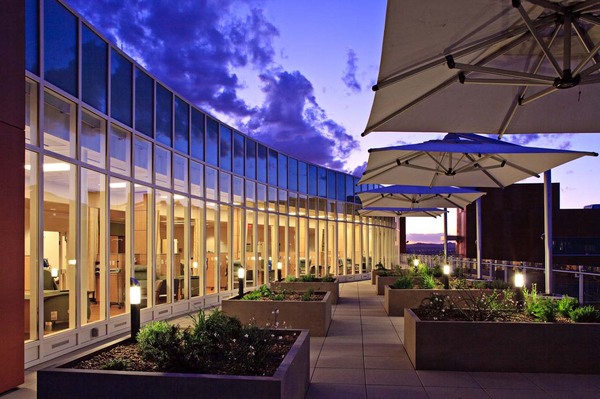
There are allot of methods out there on the web like relying on "civil twilight" tables. IME any method that does not take into account the actually brightness of a given building is going to run into problems.
I don't base my exposure on the sky. I base exposure on the lights in or on (or both) the building and then wait for the sky light level to dim to my target balance. The constant is the building lights so IME that is what an exposure should be based on.
The other issue is ones shooting direction at twilight. If one is shooting towards where the sun set, the sky is considerably brighter than if you are shooting away from it. The difference is about 1/2 hour for that sweet balance. Many times this allows us to do two or even three perfectly balanced twilight shots of the same building in the same night if we move fast, one looking east, one looking north or south and finally then one looking west (this assumes a building with even lighting on the sides we are photographing).
Another issue is clouds. I know from experience that when clouds are present the right balance is going to happen earlier and we need to setup earlier. Again the constant is the building lights we control that by our exposure. The sky light changes-we control that by when we shoot.
I make my living doing these shots. It is my bread and butter. I oftentimes have flown halfway acros the country and only have one night to pull these off so I can't rely on any method that is not rock solid. The biggest problem we face these days are sensored lights in offices-some are motion and some are thermally triggered. On few buildings is there a central over-ride. This means we have to have someone periodically moving through these spaces to keep the lights on. On one shoot recently in Reno we had 64 offices in two adjacent building over three floors with motion sensors. The lights would stay on from 2-3 minutes and there was no over-ride. We figured we needed 4-6 people running around just to keep these on. We couldn't do it. Our client was in Vegas and did not have personel to contribute in Reno. Fortunately it was a secondary twilight and not the important one of the front. Here is the project: DPS (I'm not happy with how tight some of these shots have been cropped but..........). Images number 1 and 6 show the problem side. You can't really see it because of the angles, but that is actually two buildings connected by a catwalk.
Thursday, September 15, 2011
Solar array shoot.

Solar array at the Albuquerque Academy photographed for the manufacturer. The landscaping in the far foreground, leading up to the fence was recreated in PS. All that was there was bare dirt and a huge pile of tumble weeds against the fence. We pulled down the pile of tumbleweeds, photographed an appropriate piece of landscape nearby and painted it into the scene.
Wednesday, September 14, 2011
Friday, September 2, 2011
Books about lighting interiors........?
I have a list of recommended books here on this blog that glaringly is lacking in "how to" titles. To me the weakness of most books about interior lighting is that they make lighting interiors look simpler and more formulaic than it ever is. Lighting interiors is NEVER formulaic. Each interior requires a different solution and it is hard to convey a method of "creative problem solving in the field" in a book. IMO Norman McGrath's books comes closest, but I know from trying to use it a s a textbook for students that it is frustrating to newcomers who want and expect clear formulas rather than general approaches and aesthetic suggestions. In any given shoot I will shoot some interiors with natural light, some with some light strobe fill, some heavily lit with strobe, some lit with halogens, some done with exposure blending and many with combinations of the above. How do I know what to do each time. Well 30+ years of experience helps but.......the key is learning to creatively solve lighting problems in the field. But how do you convey that especially in the face of changing technology? I have been contracted twice to write such books and have given up both times.
Anyone have books that do the job?
Anyone have books that do the job?
Tuesday, August 30, 2011
Le Corbusier & Lucien Herve-book review

I have been asked by Red Dog News to review a big new (and expensive! $75 at Getty-$46 street) book. Le Corbusier & Lucien Herve: A Dialogue Between Architect and Photographer. I just received it yesterday and it looks fabulous. It is about an extended collaboration between a monumentally important architect and his "official" architectural photographer. I'll post a link to RDN when the review is finished. This will be fun!
Monday, August 29, 2011


Thursday, August 18, 2011
Flyway View House / Jon Anderson Architecture | ArchDaily

Some of my work is currently featured on ArchDaily:

Monday, August 15, 2011
Long Beach Post: Police Chief Confirms Detaining Photographers Within Departmental Policy
AESTHETIC PROFILING? Give me a break. I too have been harassed on public streets and in National Parks for doing nothing more sinister than pointing a camera at a building or landscape. Who are they to decide what has "apparent esthetic value".
Long Beach Post: Police Chief Confirms Detaining Photographers Within Departmental Policy

One of the "offending" photographs-A photograph shot by Sander Roscoe Wolff on June 30 before he was detained by Long Beach Police. Courtesy of the Long Beach Post.
Back in my 4x5 film days I was shooting an exterior of a piano store when closed on a Sunday afternoon for the contractor. I was accosted by a security guard who said people in the nearby Starbucks had reported a man pointing a large gun at the store. Its a camera people! Give me a break.
Sunday, August 14, 2011
Digital prints for HABS?
The last bastion of old school large format film commercial architectural photography-HABS/HAER. Informative discussion on revised HABS/HAER submission requirements.
largeformatphotography
largeformatphotography
Friday, August 12, 2011
Grrrrr!
Marketing is a very frustrating long term educational effort with some new and clueless clients. The other day I gave an estimate to a manufacturer for 20 images of their facilities.
Him-"how many do I get to pick from?". Me-"twenty". "No shit" he says "the other guy is going to shoot 700 (!) in half a day and let me pick 100". I say-"With all due respect, he doesn't know what he is doing. There are not anywhere close to 700 or even 100 good images of this building. He is talking snapshots. There are however about 20 good views that will show your facilities off really well and will make you website look really professional. It will take about a long day and the images will be perfect for your marketing purposes."
He picked the other guy.
I can't wait to see the updated website.
Tuesday, August 9, 2011
Fraction Magazine: Fraction Show at Rayko
Fraction Magazine: Fraction Show at Rayko: Fraction is very proud to announce it's first photography show, Fraction Magazine : Three Years in the Mak..."
Two days till the opening!

Friday, August 5, 2011
Why an MFA?
That's a big question and I don't think my path is typical. I finished undergrad and did allot of things non-photographic for a living (welding, auto mechanics, union organizing, industrial mechanic) before starting to do commercial work a couple of years before going back to grad school. All the while I continued to pursue my personal B&W photography with a vengeance. It was ten years between finishing undergrad and starting grad school. Grad school gave me the opportunity to really think about what/why I was doing what I was doing artistically. It also gave me the credentials, self confidence and legitimacy (for NEA grants and teaching at a university level for example) to subsequently have a very diverse and rewarding dual career in academia and commercial work. It was well worth the effort and expense (I had a full ride with living expenses, plus grants but it still cost me $)."Out of curiosity what did your Master of Fine Arts in photography bring you? What were you doing before you did the MFA and what kind of work were you doing in the first 4-5 years after your MFA? I'm contemplating returning to school....." From an emailed question.
For me grad school was a great experience. I was in my early thirties with two kids and a wife, but I knew what I was doing artistically and school just kind of raised that to another level and opened doors. It was not so much what I was taught as being able to concentrate on my work in a professional nurturing environment. For the first five years after school, I went back to doing commercial work but also increasingly got shows and exposure of my personal work and started teaching at UNM part-time. It also impacted my commercial work as my kind of clientele respect formal art education and my "art shows" and publications turned out to be the best advertising for my commercial endeavors. It has been a very symbiotic dual career. The commercial work also provided the financial support and equipment for allot of my personal work.
Subscribe to:
Posts (Atom)


 Posts

