Thursday, August 27, 2009

Polaroid's Demise

Polaroid's ongoing demise reflected in the recent hubbub surrounding the sale of their photography collection, got me thinking about what a great asset they were to photographers over the years. See Polaroid

Michael T. pointed out recently "Miraculously Polaroid film and instant cameras are being resurrected by the last team and factory in Europe. Check out: www.the-impossible-project.com". This is potentially very good news, we will have to see whether the new products fit the needs of photographers.


In the late 80's I received an National Endowment of the Arts grant to photograph historic churches in New Mexico. It was a very worthy large scale documentation project of about 600 historic, largely Hispanic, Catholic churches in Northern New Mexico. The NEA grant was not going to nearly cover all my expenses. One of my sponsors was Calumet who was loaning me a substantial amount of equipment and giving me photographic paper for the project. Realizing my additional need they also recommended me to Polaroid Artist Support Program who supplied me with instant films for proofing and the what we affectionately called Fujiroid (4×5 Fuji transparency films in Polaroid sleeves-the original readyload) for the duration of the project. Their help was crucial to the success of the project and I will be forever thankful to them for their help.


Tuesday, August 25, 2009

DSLRs in the BIG City

Having just spent some time in Chicago photographing medium size sky scrappers with little room to back up, I have come to a conclusion. DSLRs and tilt/shift lenses are really stretched beyond their limit in big cities and are of marginal quality in situations where tall vertical structures are the norm. Horizontal structures like the Modern Wing shown in the post below photograph fine. But on tall vertical structures you end up using all of your rise, but you still end up having to tilt up and subsequently correct some perspective in Photoshop with all the interpolation that goes with it. I am not fully happy with the results compared to what I get photographing the lower buildings that you can stand back from in the Southwest. With lower buildings you do not use the outer limits of your lenses where resolution really suffers. My verdict? If I had to make my living working in the Loop in Chicago, I would definitely look at a first rate medium format system such as the Sinar. Of course if my primary clientele was in the Loop of Chicago, I could afford a first class medium format system.

After thinking about this today, Duh! I think my solution would simply be to revert to using my trusty view camera and scanned color negative film next time-simple cheap and fully capable of doing the job.

From Ed,

I tried posting this to the blog but I did not have the appropriate accounts. I have also struggled with the verticality of the city (I'm based in Boston) and DSLR shift lens limits. I am a stitcher also. There are a few options I've been looking into which you may already have seen that look promising. A company called Zork makes a 35mm dslr shift adapter which adapts the use of medium format lenses (645, 6x6, 6x7) allowing up to 20mm of movement if you go with 6x7 lenes. I'd probably stick with the 645 format due to the availability of a 35mm lens for up to 17mm. Since we are both used to stitching images anyway, having this level of shift could be very useful. It also allows sliding back movements for parallax free stitching which is huge. Photomerge in PS is pretty good but I occasionally get misalignment of tall building mullions if I'm up close with a wide-angle. Medium format resolution, and wide angle of view without the wide angle distortions. The tradeoff is more work at the desktop. Another option I have considered is going to medium format as you suggest but a $50k+ investment in the Sinar or a Hasselblad Shift system is just not going to happen. Zork to the rescue again. They make a MF shift adapter that uses 6x7 lenses (Pentax 67 are pretty good and cheap). The setup I am contemplating is a gently used Contax 645 (~$1,500), The Zork adapter ($1,500 which seems pricey for what it is but what are you going to do?), a range of 5 Pentax 67 lenses (~around $2k for all 5 from KEH.com!) and a factory refurbished Phase One P25 22mp back (which is fine resolution-wise since we are stitching) from Calumet for around $12k. Total cost around $17k. That is still a chunk of change but way less than the Sinar or Hasselblad. I probably have $10k invested in 35mm so not so far off. Maybe you would be so kind as to try out these options for us and report about it on the blog! Also, check out 16-9.net. Here is a link to a roundup of possible shift solutions for anyone used to working in 35mm DSLR:

http://www.stitchpix.com/options.html

Avoiding Parallax:

http://www.outbackphoto.com/workflow/wf_58/essay.html

Other Links:
http://www.zoerk.com/pages/p_psa.htm http://www.contaxcameras.co.uk/645/645.asp http://www.keh.com
from David:

Regarding your recent comments on shooting tall buildings in the city: wouldn't the new Canon 17mm ts-e be of some help here? I know, you'd have to crop somewhat, which reduces quality, but wouldn't that at least be preferable to perspective correction in Photoshop?

Some further thoughts. The issue for me is simple. I have written many times that, coming from 4x5, to get acceptable quality from a DSLR requires very very careful work, minimizing everything that might diminish image quality like , camera movement, cropping, lens distortion, shift limits, diffraction, interpolation etc. In Chicago shooting in the Loop, where my 24 t/s had insufficient rise resulting in stitching vertical frames (that had some necessary converging vertical lines), that too many image deteriorating factors came into play to give me the quality I want. In many cases (street corner buildings) I simply could not get back far enough to avoid these issues. These factors included barrel distortion correction, significant perspective correction and cropping. In one situation I had to shoot from the middle of the street in a crosswalk and actually had to handhold the camera a situation which makes my skin crawl.

Now these images are not being used large, websites or catalogs, and with allot of work I can make them acceptable, but I always try to exceed my clients expectations. I have said before, if you routinely exceed your clients expectations, your clients recommendations will become your best advertising, if you exceed their expectations too much you probably will not be profitable and won't be able to make a living. In the short run to build your initial portfolio this may work, but in the long run you need to control your costs and be economically competitive.

The easiest solution is simply to go back to using my view camera for these shots but I did not anticipate this problem. Using my Schneider 47XL and a center filter (to correct for the lens fall off) on roll film would have worked because of the significantly more rise and less lens distortion I would have had compared to the DSLR with last generation T/S lenses (I would have bought the new 24 before the trip if I could have found one with a US warranty. It at least has less distortion) or use a good 75mm on 4x5. In the comments below another Ed, from New Orleans, suggests a similar and very viable retro option:

For the $1500 the adapter costs, you get a Sinar F2, 90mm and 75mm lenses, and do a better job. Since you are shooting for a client, the film cost should not be an issue.

Kirk, could you elaborate a bit on working in tight city spaces with the view camera? I am doing more shooting in New Orleans, which has some wonderful late 19th century, early 20 century facades, but also has some pretty narrow streets. Should I start saving for a 72mm XL?

Ed from New Orleans,

As you know your solution is perfectly viable and very inexpensive. Film for me can no longer supply my needs for commercial work as we no longer have a lab in this town and doing color myself or shipping it out is just too slow a turn around. BUT for odd necessary shot or my personal work that is no problem. I have coveted but never owned the Schneider 72XL for 4x5. I have owned 75s and 65s but those were of limited coverage on 4x5 and not suitable for extreme rises for tall buildings. If I remember right the 72XL has great coverage (like 226 mm diameter circle of coverage-that is a front rise of 48 mm with the XL vs. 31 mm with the 75 ) and should do the trick. As you are scanning your film you can get by without a center filter which helps alleviate falloff. I have successfully used a white gradient for years to fix falloff. You also need a really solid camera and preferably bag bellows. The extreme movements needed with even a very flexible "universal" bellows can force the front standard to tilt forward with extreme rise. I also prefer for my large format architecture lenses to mount them above center on the lens board to maximize rise. We always seem to need more rise shift than fall (and we can always reverse the lense board and mount it upside down to get more fall). This discussion makes we want to break out one of my 4x5s (I still own two) and go shoot some film! One other thought, though the ability to actually use this solution is rare. Check and see if there is a roof or window across the street from the building you want to shoot that is about half its height. That alleviates the need for such huge coverage lenses and provides an interesting birds eye view from about mid elevation of a tall building. It is also visually appropriate to leave a slight amount of convergence on really tall buildings or they tend to seem like they are falling forward Think also about using really long exposures to significantly blur cars or people. It is virtually impossible to avoid them when the light is right on a building so blur can make them less distracting and provide a juxtaposition to the solidity of the structure.

The solution David suggests about using the new 17 T/S above may have worked but includes significant cropping and may compromise the file to much. It is hard to say without testing that lens. The suggestions of Ed to buy a used Contax 645, Pentax lenses and a Zork adapter......I wonder. Those Pentax lenses don't have that much excess coverage beyond a 6x7 negative size. How much shift are you going to get? I will not be trying any of these options myself soon as my equipment budget for the near future is the new T/S Canons, a new computer for file editing and my oldest daughters upcoming wedding!

From Tonnes:

I suppose if you were in a bind with nothing but your digital camera and didn't have enough rise using your 24 TS-E, you could use a really sharp tele like the 85mm F 1.2 or 1.8 and shoot a vertical panorama of the building. Provided you had enough time to shoot the sequence and you're comfortable using a stitching program like PTgui, the resulting gigapixel image would interpolate very well when you corrected the verticals, no? But ultimately if you try to shoot a tall building from too close, regardless of how the verticals are corrected (optically or in post), things can look weird - namely, the windows get progressively shorter towards the top.
Tonnes,

As you say, in my experience with that kind of complex stitching of buildings from close up, there is always a fair amount of distortion that cannot be adequately corrected, and the resulting files are just not up to the standards or me or my clients. From a distance this is not an issue and multi-tile stitching is a great way to build quality large file sizes (of potentially unlimited file size for huge prints). Also, for me anyway, AP has become a bit of a volume business and I would rather invest in the proper piece of equipment so I can work quickly rather than laboring over multi-tile stitches and assembling them and correcting them in PS. Billing for all of that would not make any sense to my clients.


More to come.......

"What is the Difference Between Art and Fine Art Photography?"

An often asked and good question, one I contemplated allot when I was a student and am still to this day trying to figure this issue out. It is hard to define because we live in an artistic environment which attacks neat definitions and tries to destroy conceptual boundaries. So really the best I can do is give some personal reflections.

I think the Wikipedia definition is a good starting point though:
Quote:
Fine art describes any art form developed primarily for aesthetics and/or concept rather than utility.[1] This type of art is often expressed in the production of art objects[2] using visual and performing art forms, including painting, sculpture, music, dance, theater, architecture, photography and printmaking. Schools, institutes, and other organizations still use the term to indicate a traditional perspective on the art forms, often implying an association with classic or academic art.
In my own lexicon, as both a commercial architectural and "fine art architectural" photographer, I find the first sentence of the WP definition to have some merit. Though the boundaries are certainly not distinct, in my commercial work as an architectural photographer, much of what I do is find ways to illustrate the aesthetic ideas of my clients ie interpret someone else's art. I am oftentimes trying to get into the head of my client and create images that are artistic but useful (have some utility) to them in design competitions, proposals slide shows etc. Aesthetics and illustration must be balanced lest you stray too far from your clients needs. Vice versa if you don't pay attention to aesthetics then you create boring documents, which may not "sell" your clients work well. At the far aesthetic edge of this commercial work are those clients who want me to just go out and "do what I do", which means to interpret their work aesthetically. See this Abstraction thread in my blog. To use this image again for an example- while making this image last week of the modern wing at the Art Institute of Chicago, my assistant remarked something like "that looks allot better than the building actually is". To which I said this is more like advertising photography than documentary". A former student of mine, he does HABS documentation and is quite good at it. Actually in all fairness the Modern Wing at AIC is an extraordinary design and photographs are hard pressed to do it justice.


An effective commercial architectural image illustrates and sells the clients creations. It is all art but different in concept and approach and intent than my personal work which when successful I refer to as my Fine Art. The fine art is intended primarily for aesthetic contemplation, though there is a visual reality to work from and oftentimes there is a descriptive intent such as trying to bring to life the spirit of a particular place. Aesthetic contemplation is a kind of utility but far more personal than public as in my commercial work. The FA work also illustrates but it is illustrating my feelings about a place as much as its visual reality, which leads me to much manipulation of tone etc that exceeds documentation. So aesthetic contemplation, strictly speaking of is role in my life has a more profound purpose and personal utility and I distinguish that as my Fine Art.

There are huge areas where my own definitions don't hold much water. For example I have been part of city public arts commission projects with fairly strict limits on subject matter. Is this commercial illustration or fine art? I have struggle to accomplish the latter while honoring the boundaries set by the city/client. Many observers of my work don't see my distinction between commercial illustration and fine art and see the commercial work equally as creative as the FA and the FA work equally as grounded in real time and place as the commercial work. Also ironically, some of my favorite FA work has come out of HABS documentation projects. For me it is a personal distinction that helps me focus on what is important in each endeavor, but not an aesthetic straight jacket.

Just some of my personal views on the subject based on my own work............and an example of the personal FA work, the upper Morada in Abiquiu. Does any of that make any sense?

Wednesday, August 19, 2009

Shooting for magazines for free?

This post comes from a thread on Luminous Landscape (Free).

Do magazines in areas like food/architecture/sports, etc. expect photographers to work for free?

Magazines that EXPECT photographers to work for free are probably marginal and won't give you the exposure you expect. Any quality publication EXPECTS to pay for photography though the rates may be pitiful for assignment or stock.

I happily do allot of editorial, mostly architecture related (but not exclusively) for local, state , regional and national magazines. Though mostly architecture, recently New Mexico Magazine asked me to illustrate an article on Rudolfo Anaya, a friend I rarely see. It was a treat to work with him. he is a state treasure. The fees were adequate. Overall, the rates are poor right now with some magazines (but not all), but far from free and the difference I can often make up in the stock sales of images from these shoots. These editorial shoots also generate client contacts, high profile exposure and keeps my assistant working during slow times. Editorial also gives me access to unusual locations for my personal work and gas money to get there on someone else's dime. Editorial and the stock it generates is now and always has been been a vital part of my income and marketing strategy. With most magazines my fees are reduced but I have gotten full fees from some publications (pre-recession).

The only time I do free work is for friends, family or occasionally non-profits I support.

Thursday, August 13, 2009

A Chicago Trip

I've been in Chicago on an extended shoot and will get back to blogging after I return and get some rest. I love this town. It is a museum of great architecture. Here is a quick sample from the trip, Renzo Piano's new Modern Wing at he Art Institute of Chicago. It is one of my favorite pieces of architecture I have seen in years. Superb.

Wednesday, August 5, 2009

Julius Shulman Passes at 98


The Kaufman House, 1947

Julius Shulman, probably the most prominent architectural photographer of the 20th century has passed. His work defined early modernism in the architecture magazines. The book "The Photography of Architecture and Design" is a classic that influenced virtually every AP I know, myself included.
Julius Shulman


Monday, August 3, 2009


Photographer Laura Gilpin Comes to Life
A Through the Lens Chautauqua event
6:00 pm to 7:30 pm
Deborah Blanche will recreate the life of legendary Santa Fe photographer Laura Gilpin during a Chautauqua performance in the History Museum Auditorium, 113 Lincoln Ave. A free, public event.

In this show, meet “Miss Gilpin” as she was in the year 1954 – a confident, ebullient woman in her early 60s. As Miss Gilpin, Blanche narrates a slide show that includes images from the photographer’s first Lumiere color prints to many from her best-known book The Enduring Navajo. (The slide show of 30 pristine images is made possible by arrangement with the Amon Carter Museum in Fort Worth, Texas.) Miss Gilpin will answer questions from the audience and tell some of the behind-the-camera stories about the photographic retrospective that parallels her life.


Laura Gilpin was a pioneer of architectural photography in the Southwest, though she is best known for her landscape work. She was a principle photographer of the designs of architect John Gaw Meem, who many see as the father of "Santa Fe Style". Laura Gilpin and I had a show together at a long defunct gallery in Santa Fe back in 1973 or sometime. She was a great lady. I enjoy her work and life immensely. I think this Santa Fe program could be quite interesting if you are in the area. This is part of the "Through the Lens" exhibit, which I have a small role in.

Steps of the Castillo, Chichen Itza
By: Laura Gilpin (1891–1979)
Image is located at Amon Carter Museum, Fort Worth TX. Gelatin silver print (bromide) on Gevaluxe paper

Friday, July 31, 2009

Fine Art vs. Commercial Photography

from Max:
Hi Kirk,
I would like to say thanks for your dedication to fine photographs. I share your appreciation of architecture. I also like the way you've managed to combine your commercial photography preference with your artistic aspirations and vision.
I suppose it's a common struggle. Your site makes it all seem like one.
Thanks Max. "Seeing it as one" was a long journey. I "grew up" artistically in an environment that disdained commercial photography at the renowned University of New Mexico Photography Department of the early 70's. This was during the rein of legends such as Van Deuron Coke and Beumont Newhall. Commercial photography was somehow tainted. Some years after graduation, I got into commercial architectural photography because I had a family to support and I was not accomplishing that strictly doing art photography and showing in galleries. Mentally it was not a happy marriage. I considered art my passion and the other what I did to support my passion. That doesn't mean I approached architectural photography with a lack of sincerity. Everything worth doing deserves serious attention, but commercial photography was, in my mind, definitely a second class citizen.

I defined the distinction this way. My art was illustrating my own ideas while the commercial photography was illustrating my clients ideas, but over the years that commercial point of view didn't hold water. Clients were hiring me to see into their designs. They were asking me to interpret their art. Many of the best designers I worked for didn't even do a walk through with me-sending me out to "see what I came up with". They saw me as an artist interpreting their art (that isn't to say that there is not a documentary aspect to AP, because there definitely is. You have to show the building). Many of these same architects are aavid collectors of my b&w work too.

In 2003 New Mexico magazine approached me about doing a retrospective book of my work, which became Shelter from the Storm: The Photographs of Kirk Gittings. I suggested a collection of my B&W, but they wanted it all. It was inseparable from their POV. I could not figure out how this would work organizationally or visually. I tried many times to come up with a workable draft, but I couldn't see it and finally turned the project over to their designers. My conceptual separation of the work was a barrier, but not for them. This experience really made me re-evaluate how I see my commercial work. It is more seamless for me now as a result of that project. I learned allot from that experience. Is there really a fundamental difference where a commission comes from, whether from a commercial client, an arts program or my own internal quest? What about being invited to participate in a group exhibit with a theme? Here is an example from a show where 20 photographers were asked to photograph the same model. Model Rose Bryant photographed at the ruined 17th century church at Quarai (Canon 5D, 24 T/S).


The experience led me to (or back to really, I had played with this some years ago) an interest in photographing figures in architecture and landscape, and led to a recent arts commission to photograph figures in landscape around Albuquerque. I don't find client requirements to be barriers to creativity, but instead stimulus to creativity.

Tuesday, July 28, 2009

Stitching programs for files from Tilt/Shift lenses.


I do allot of stitching these days for clients, usually a half dozen+ on every shoot. An effective stitching program is a must. I have stated before that I prefer Photoshop CS4 Photomerge over programs like Autopano Pro or PT Gui for flat stitched architectural images and the images below will illustrate why. Above are jpegs of the original raw files, Canon 5DM2, Canon 24T/S. The method was to simply level the camera-shift up and expose and shift down and expose. NOTE, the camera must be on manual exposure and the white balance set (4000 K on this) so that the exposure and white balance does not change automatically between exposures (I only use manual exposure normally for architecture anyway and expose based on the histogram). Below are the renderings of the images in Photoshop Photomerge and Autopano Pro. AutoPano Pro with its "best" projection mode (Planar in this case). It introduces allot of pincussioning that requires additional time in PS to correct.

This file is straight from the raw files in bridge via the PS Photomerge script. Photoshop Photomerge preserves much better the straight lines of the original files,


I find Autopano Pro to be superior for large multi-tiled landscape stitches. It seems superior at blending edges in skies and finding control points in clouds etc. But for my daily architecture bread and butter with Tilt/Shift lenses? Give me Photoshop CS4 Photomerge.

I discovered this problem with architecture in Autopano Pro this week because my PS Photomerge could not align any two images to save its life. With deadlines to meet, I was panicking. So I tried Autopano Pro and PT Gui again. Neither performed as well as simple PS Photomerge. It turns out that my problem in PS was a corrupted Preferences file and as soon as I erased that (the program will recreate it) the stitch program in PS ran fine. People tell me that it is a good idea to save a clean copy of your preferences file and replace the existing one at the first sign of trouble in PS. Where this is located depends on your operating system and PS version. So you will have to investigate this online. It is a fairly well known issue apparently.

For an alternative take on AutopanoPro see Jack Flesher's post on LL

The Kira Sowanick, AIA, Residence, Albuquerque, NM.

Sunday, July 26, 2009

Sorry All

I have been absolutely buried with work and have had no time for the blog. I will get back with peoples comments and emails after the end of the month probably. There are three design competition deadlines at the end of the month-my yearly bread and butter. Thanks for your patience.

Thursday, July 9, 2009

Abstraction in Architectural Photography: some thoughts.

"Between documentation and interpretation? How much of each is necessary or desired?"

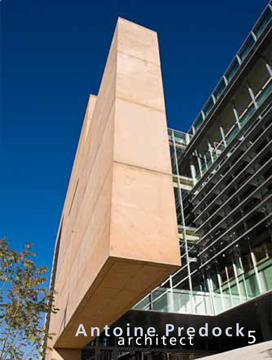
The answer for me, when the client is an architect, both. I am paid for both my eye and technical expertise. All photography requires interpretation just from the basic activity of framing an image, making a visual selection, but for some images it goes far beyond the process of selection. Over the course of an entire shoot, I must deliver images that both accurately depict the volumes, masses, setting, facades etc. and I must deliver images that interpret the feel of the design. It is in attempting to interpret the feel of the design where I am most aesthetically free. Here are a few examples that I did recently for a project. I'm never sure that the client will appreciate some of my more abstract interpretations, but usually my more creative clients appreciate my more creative images. Project, the Aperture Center, Mesa del Sol, New Mexico, Antoine Predock Architect.


Some of my favorite images of architecture are extreme abstractions that don't illustrate the physicality of a structure but speak to how design feels. Oftentimes these images fall on deaf ears (blind eyes?) and move no one but myself. But my more creative clients appreciate them. Here are examples from the Aperture Center shoot (above) designed by Antoine Predock FAIA with Jon Anderson Architects. Below are images I "encountered" while waiting for the light to get better!

Markets, Marketing and Fees: some thoughts.

Hey Kirk,
I want to compliment you on your blog. It's very informative and entertaining. I am an editorial and commercial photographer based in the Midwest. I have shot quit a bit of architecture in the last year for a few editorial clients. I find it very rewarding and am looking into shooting more architecture. I am wondering if you would be willing to share a little bit about your business model? My clients in the past have all been either magazines or advertising agencies. I am wondering who I should start marketing for architecture work. I'm also wondering how most people are charging? Day rates, project rates, usage?
Any info you can share would be greatly appreciated.


Thanks for the kind words. This is a big topic and I will add to it over the next few days so check back in. Who do you market architectural photography too? Who needs it the most? Architects, builders and "shelter" magazines. My largest volume clients are magazines, then architects and finally builders (and occasionally ad agencies). Part of that order is choice. I find builders to want the most pedestrian images and want bid photography, so they are my lowest priority (not always for sure, but generally speaking). Magazines have the most varied projects, which is stimulating, but generally don't pay great (not always though). Magazine work is your best advertising, so the low fees notwithstanding, magazines have their silver lining. Having studied art at the university level, architects and I speak the same visual language. I understand their needs the best and they value creativity. Hence, they the most
challenging and pay well.

My original strategy 30 years ago was to build a clientele amongst the less demanding builders as I built my portfolio, equipment and expertise. I then used that base for leverage to gain more lucrative and visually sophisticated design and magazine clients. For instance when shooting an important building for a contractor I would call the architect and ask if they need some photography too or want to share in the shoot. This strayegy worked so well that Iwould do it again if I had to start over again.

Variety is important from a economic stability point of view. When one market like residential may be down big commercial buildings may be stable or advertising in magazines may be booming. Right now residential is in the dumps but commercial is holding its own. That may switch next year as residential climbs out of the hole and commercial, which has a much longer lead time, starts to slow down. With residential seeing the light, magazine advertising (which pays for editorial) may boom as clients start to position themselves for the end of the recession.

Variety is also important in terms of keeping the creative juices flowing. A large office building is a very different challenge than a residence and I find those different challenges very stimulating.

There is no single fee strategy that works in all these markets. A national manufacturer will expect to pay far more than your neighborhood contractor. Day rates are still very common out this way, but even for me those vary tremendously depending on the size of the client and usage required. Fees for small local clients would make your skills suspect for large clients from major metropolitan areas. You need to know what is happening in both and position yourself based on your expertise and competition.

Without going into personal details, for a regular architecture documentation shoot, I have a shooting fee/day rate (which varies greatly depending on client), digital capture and processing fees (per image, multiplied for stitches, this is aimed at paying me a reasonable hourly rate for all the computer time), assistant fees, travel fees (if required), multiple copyright user surcharge (like say the architect and contractor want to split the shoot-it runs about half the shooting fee per additional client) and miscellaneous charges. These days we do approx. 30-40 images a day when documenting architecture, far more than we ever did with film (largely because digital is far more forgiving in mixed light situations so we can work faster). Art directed shoots for say a magazine will produce far fewer images.

Before the recession I was able to charge pretty much what I wanted without oftentimes even being asked for a proposal or estimate from established clients, but that has changed drastically. Recently I have even initiated significant fee reductions with some key magazine clients that are having trouble. Why? My business is largely built on long term relationships, some 30 years old now. We have gone through the highs and lows together and I want them to know I have not gotten so established that I'm inflexible and that we are still in this together. My general rule of thumb when the economy is growing? If you are established with clients that don't need to be educated about the value of AP? You should be having to do a hard sell about a third of the time to justify your charges. That way you are maintaining your base but always pushing the fee boundaries of your clients expectations. When no one is complaining about your charges-time to raise prices. We will get back there again, but if we are lucky it will be in two years.

New Mexico has not been hit as hard as many states and municipalities. A recent newspaper article indicated that house sales here were rebounding much faster than the national average and that stimulus money was already interring public sector construction in "shovel ready" projects. I feel for all you in some of the worst hit areas. I have a successful AP friend in the Midwest that is working at Hobby Lobby. Really tough. But I admire his flexibility. Do what you have to do.

A painter friend has an interesting recession strategy. With art you can't really back off prices without devaluing the purchases of previous clients. He raised his prices 20% and then told his galleries to offer a recession discount of up to 20%! It seems to be working for him.


More thoughts to come. I am buried with work so the strategies must be working.

Saturday, June 27, 2009

Book Review: Craig Childs' House of Rain


Craig Childs luminous 2007 book "House of Rain", about the Anasazi ruins and landscape of the Southwest, is a recent favorite of mine. I have savored this reading experience, reading it in small bites over a course of months. It is not about architecture per se or photography at all, but for me it sets the stage for much of my personal photography, like a quite church for prayer-reminding me of where I have roamed and where I wish to go. In prose that oftentimes resonates like poetry, Childs' vivid experiences, walking the ancient Anasazi trails of the Southwest, remind me of the many miles I have lugged a 4x5 to remote ruins in hopes of finding the fine light. It also reminds me of my successes and failures in that quest and of the richness of the experience regardless. But Childs' is a wanderer of biblical proportions seeking the promised land of his inquiry across the desert Southwest (for example Childs walked the Great North Road out of Chaco Canyon all the way to the ruins in Aztec NM. That's lmost 50 miles across the desert! I feel like I have walked many miles of various Chaco roads, but pathetically I doubt it adds up to less than 15 miles in total).

Slightly on the fringe (or leading edge?) of Southwestern archeology like Steve Lekson (The Chaco Meridian), Childs presents some fresh and controversial ideas about large scale migrations of the Anasazi and their descendants from New Mexico to Utah, south into Arizona and finally into Mexico. It is a sweeping tale on a continental scale, well researched and investigated and told in a lively experiential style,

Childs is one of those naturalist writers, like the late Loren Eiseley, whose sense of place transports me in space and time. His descriptions of regions like Comb Ridge Utah make me simply want to load film, jump in my car and roam. I have not been so moved photographically by a book in in a very long time.

Don't buy this book if you are looking for locations of great sites. They are only described in the vaguest of terms. But if you have spent much of your life, as I have, stalking these haunted places. This book memorably captures the spirit of that quest.

See: HOUSE OF RAIN

In addition I can recommend his "The Secret Life of Water". Together both books are a visionary tour de force about the SW landscape.

Thursday, June 25, 2009

Flourescent Fill Light?

From a question on the LargeFormat Forum about using 6500K fluorescents for interior fill on a cabin shoot with Fuji 50 film.

The Fuji 50 transparencies will come out very blue green. Nor will the flourescent fill lights be bright enough if you are trying to balance interior light and daylight, such as an interior balanced with the exterior through the windows (unless it is at twilight).

Additionally, The eye sees flourescents differently than film. Photographic daylight is 5500K. So if they are correctly represented, they will be cool to the tune of 900k. They will also be green on film which the eye does not see. How much? Depends on the light, but will probably require somewhere between 15-50 magenta to correct.

The best way, if the room fixtures are flourescents is to use the same bulbs in banks for fill. Then balance the film to all the bulbs.

What to use? For film I would never actually use flourescents at all, as all the bulbs are different and require testing to get the balance right. I own and used for 30 years a color temperature meter, but it was not super accurate for flourescents with transparency film. Based on experience I could make an educated guess, but testing was the only way to get it right. Personally I would use halogens with Rosco blue filters to bring them to daylight. By the way, I would not use Velvia 50. I would use a faster film,as you are going to have very long exposures with reciprocity problems etc. I would actually use a color negative film like Fuji Pro 160 and scan it.

But to be really truthful? I wouldn't shoot film for such projects anymore anyway. Digital is far superior in such an application. It is much more forgiving and flexible in these circumstances. Plus you can see what you are doing much better than we could proofing with Polaroid.

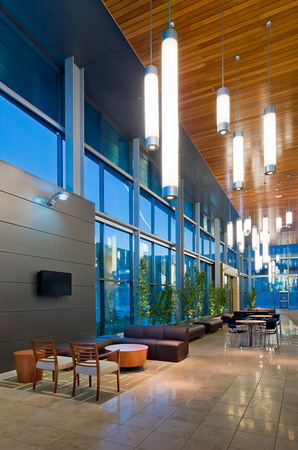
Shot for a local construction company, with some very slight color color correction in PS, a digital image of an interior lit by flourescents and daylight. White balance was adjusted for the foreground. Simple. This would have been much more complicated on film.

Wednesday, June 24, 2009

Medium Format Digital Snobery?

Have you been demeaned by a medium format digital user for using a DSLR for architecture? I hear this regularly in forums from "big time" photographers and workshop instructors who have the fees and resources to shoot MF digital. There is NO doubt that MFD outperforms DSLRs for architecture. BUT there is also a huge cost/benefit issue, like a $50K MFD investment vs. maybe $12-15K for a top DSLR kit. The vast majority of AP out there cannot afford, nor do their clients require, that kind of quality. It is simply overkill (as 4x5 film was overkill too for 98% of clients needs. See From 4x5 to DSLR). That kind of equipment "one up man's ship" is ultimately about selling oneself-measuring themselves and their resources against their competition (regardless of client needs). It is mainly marketing hype.

This attitude is an especially disappointing coming from architectural photographery workshop leaders, who leave students shooting DSLR with the impression that their DSLR equipment is so inferior as to be unusable. As I have stated many times, I work for some of the high level clientele that he does (though most of my work is local with smaller budgets) and my top flight national clients have been totally satisfied with my DSLR work. See also From 4x5 to DSLR.

Do I want more quality? Absolutely. Always. But the cost/benefit equation must meet both my client needs/expectations and mine. Buy into a MFD system? I would need to justify about a two year write off. Once you start chasing that dog, it never stops. I can do that chase with DSLRs and stay very up to date AND profitable even with mostly local clients and editorial architecture. As it stands now in terms of file size (MFD vs. DSLR is not just about file size but image quality too) a 21mp camera file meets 99% of my client needs WITH some clients complaining that the files are TOO BIG.

As per workshop instructors? We all have our varied experiences and biases. I wouldn't take such criticisms personally. Oftentimes an established photographer has a very different frame of reference than the students do. I would take the workshop and learn what fits ones present circumstances and future aspirations. In my experience, if I walk away from a workshop with two or three really valuable lessons that allow me to save time, make more money or see clearer, I usually feel like it was money well spent. But again there is a cost/benefit issue with workshops too.

Kirk

from tonnes

Excellent advice from Kirk...can't really add much except to emphasize the cost of the esoteric digital backs and how quickly you must amortize them. Unlike the good old film days, digital capture technologies are rapidly changing, meaning that today's $40,000 MF back will lose most of it's value in 5 years because in 5 years you'll be able to replace it with a DSLR that's 90% cheaper, has equal or more megapixels, more dynamic range, faster capture, higher ISO's, lower noise, etc.

Are MF backs necessary for success in the AP business? Absolutely not! The guys at Attic Fire (see: Attic Fire) use Canon gear and their lenses are the "lowly" 24mm tse as well as the 17-40 and 24-70 zooms! They've developed a unique look and feel to their images and it is their strong post-processing techniques which sets them apart - not the gear they use. They are a busy firm with a stable of top-notch clients - mostly in the hospitality industry.

There are gear snobs and there are successful photographers and they're not necessarily the same people.
 
Add to Technorati Favorites