Friday, February 26, 2010

The Ultimate Architecture Camera? ARCA RL3d


“Need a few more million?”

“The RL3d is the dream camera for 4x5” photography”

“A universal system with modular elements”


The new RL3d is available now!

This state-of-the-art professional viewfinder camera comes equipped with new functions for making great high-resolution images both digitally and on film. Following the success of the Rm3d, ARCA-SWISS has introduced the RL3d, a universal camera with increased shift, opening up new horizons by enabling you to take images in multiple formats up to 4x5.”

Capture the real moment

Ever dreamed of a few more million? Or wished for higher resolution? The RL3d, with its ability to produce images of over 200 Mb, will make your dreams come true. It allows you to take fantastic quality images – from medium format to 4x5” - with the utmost ease and efficiency, using a high precision hand-held camera.

Despite its solidly build quality, the RL3d remains light and compact and ideal for location photography.
The ARCA-SWISS R-Line has six exceptional functions to improve efficiency and ergonomics and help you capture all sorts of images:
- All In Plane vertical and horizontal shift
- An integrated ± 5° horizontal or vertical tilt function to provide optimum sharpness where required (Scheimpflug effect)
- Focus distance can be measured and displayed electronically
- Camera level can be found electronically* or using conventional spirit levels
- The camera comes equipped with focus sensors; framing is achieved using the new variable Vario viewfinder which covers focal lengths from 23 – 210mm.
- Lenses are fitted onto the ARCA-SWISS R via an exclusive bayonet mount. By equipping lenses with a bayonet mount and by opting to link the optical system to the helical focus mount, they can be used both on the RL3d and Rm3D, as well as a bellows camera.


* via the electronic module. An optional accessory. For further information, see page 3

Versatile

Photographers using the RL3d will be able to take pictures on film or digitally in a multitude of formats up to 4x5”. Thanks to ARCA-SWISS’ wide selection of interface plates it is possible to take anything from medium format
images through to panoramas. The extraordinary versatility of the modular ARCA-SWISS photographic system
enables you to use elements from the F- and M-Line cameras as well as a binocular viewer, lens hoods, bellows and other accessories to significantly enhance the functionality of the ARCA-SWISS R-Line.

The optional electronic module extends its versatility even farther as it electronically calculates and displays data relating to level, distance from the subject and focused distance, as well as depth of field.

The quality of the image is determined by the choice of digital or film back, and by the type of film or format selected. It is easy to use as a hand-held camera and enables you to do away with a tripod, particularly in tricky situations such as construction sites, working on scaffolding or even on ladders.


RL3d® technical specifications

Horizontal Shift 40 mm (20/20)
Vertical Shift 50 mm (10/40)
Tilt (horizontal or vertical) ± 5°
Weight (body only) 1500 gr
List Price $ 6490
(body, international back with ground glass and Fresnel lens)

Why stop there!

The ability to shift the lens has eliminated perspective distortion and the tilt or swing movement has extended the depth of field. The integrated bubble levels make it easy to keep the camera level, ensuring images are perfectly straight and accurately reflect reality. The shape and position of the hand grips make it easy to switch between landscape and portrait without having to change the position of the viewfinder or back.

Lenses are mounted using the exclusive ARCA-SWISS R bayonet system attached to a helical focus mount.
Its large diameter does not restrict the choice of lenses. The micro-precision helical focus mount, which has precise control using 1/100mm increments, is part of the R-line body guaranteeing extreme precision. The very bright multi-focal zoom viewfinder eliminates stray light and informs the photographer what movements are required. It also offers tips: points of light appear in the viewfinder generated by the format mask to indicate the amount of shift required. Each point of light equates to 5 mm of shift. The viewfinder bracket is identical to the tripod bracket, enabling the photographer to turn the camera over and thus achieve the maximum amount of shift both upward and downward.

All cameras come equipped with focus sensors. The electronic functions are provided by a separate optional electronic module that provides a wealth of information! It uses a ultrasonic device to measure the distance between the camera and the subject and also provides information on the distance on the focus ramp, the depth of field covering four F-stops and the camera level in any position.

The ARCA-SWISS R-Line cameras come with two built-in tripod mounts for regular or up-side-down configuration, but can be also slid onto a monorail to attach a bellows for the use of longer focal lengths. The R-Line extension kit provides a variable extension for use on long focal lengths or for still lifes.

The unique ARCA-SWISS Rotaslide® sliding back enables you to switch quickly between ground glass and digital back. This sliding back also enables you to rotate the digital back from landscape to portrait without having to remove it.

A wide selection of film and digital backs can be fitted to the ARCA-SWISS RL3d. A high-quality camera for high precision, high quality work!

Press contact: Maud Huot-Marchand - Email: comm.arca-swiss@orange.fr

MY thoughts:
Really sweet camera. I know of a couple of top notch commercial architectural photographers who are planning on buying one. They really are the state of the art.

However, I'm not likely to be one of those purchasers unless I win the lottery, but heck if I win the lottery I can quit doing commercial work and just shoot my personal work on my beloved 4x5 Phillips and film! Frankly for commercial work, I do just fine carefully using a DSLR. A 21mp camera produces files that many of my clients consider are too large and the new Canon T/S lenses are superb.

Now, if I actually got the chance to try one out, it might totally seduce me.............maybe. I think not. Using the Canon 5D II and T/S lenses is so effortless and fun, creativity just flows.

I have never bought into the idea that you have to buy very expensive equipment to impress your clients. Heck in the view camera/film days I used a $175 used Calumet Wide Field for 15 years (and not at the beginning of my career either, but something like 1991-2006). What if-HEAVEN FORBID-your client owns a better camera than you do? Its not about who owns the best equipment-but about who can SEE architecture and utilize equipment to make that vision a reality.

Wednesday, February 24, 2010

Tripod Heads.


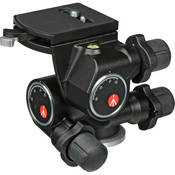
I was reminded about this again by a discussion over at Luminous Landscape. Over the years I have tried allot of tripod/head combinations for shooting architecture. After being introduced to the Bogen 410 head by some large format friends, I tried it and was sold-even for DSLRs. I never looked back, putting it on all my tripods. That was a few years ago now and I still consider them top notch. FWIW I also know some top national APs who swear by them too.

It allows for both quick gross adjustments and really fine adjustments. The quick release plate is rock solid and the whole unit can be found new for like $210-225! Yes there are better lighter heads from Arca, like the Cube, but LOOK at the price $1700!

Over time, the adjustments get a little sloppy, but the slack can easily be taken out by removing the caps and adjusting the set screw.

I love reasonably priced photo gear that gets the job done.


Late addition:

Ed has pointed out one problem with this design. You cannot point the camera straight up. This is rarely a problem for me, but Ed likes to shoot church ceilings. My solutions are to reverse the orientation of the quick release plate on the camera, effectively mounting the camera backwards on the head. This works perfectly but requires that you have a heavy duty screw driver or something with you to remove the plate and tighten it back down again. I like to keep my plates super tight. The other option is my preferred method. I carry a Manfrotto 394 Low Profile Quick Release Adapter with 410PL Plate (46.50 from B&H). With this I can quickly reverse the mounting position of the camera. It is set up permanently in the reverse position.

Saturday, February 20, 2010

Design Competitions-Beyond the Beauty Shot II.

Ed commented on the previous post via email:
Interesting choice of words - I think I heard that before in my research
on VD.:-)
Ed,
A few thoughts from an architectural photographer who teaches at two architecture schools. I think Susan is exactly right in her assessment of the limitations of most design competitions, but who is responsible for those “pretty pictures” being submitted. The images I make for a client, such as an architect, have to serve many functions, including design competitions (documentary) and advertising (hyperbole). These are many times mutually exclusive in terms of how far I take the processing of the files. If the client thinks that the hyperbole is inappropriate for the veracity demanded by a design competition they could certainly ask for a “straighter” set of files-BUT NONE EVER HAVE! They are responsible for what kind of images ultimately get submitted for a given purpose. Design competitions are seen as a form of marketing and handled by the marketing department of most firms. More importantly, most design competitions are conceptualized by designers who have bought into the idea that design competitions are a form of marketing.


I doubt that your average AIA design competition will change much. It is simply much easier and cheaper to email a PowerPoint submission to a judge 3 states away.


Wednesday, February 17, 2010

Design Competitions-Beyond the Beauty Shot.

Beyond the Beauty Shot

A thoughtful article by Susan Szenasy in Metropolis Magazine about the inherent problem of judging design competitions based on (our) "pretty pictures".

My main thought......she is absolutely right, though because of budget and time constraints this will never change, and......don't get your knickers in a twist.......for us (APs that is)....... its not our problem. We are just servicing our clients wishes.

Tim Street-Porter

There is a good article in this months issue of American Photographer on Tim Street-Porter, an LA based architectural photographer. He is one of the best. His books on Mexican Style architecture are classics that defined a genre. Unfortunately the article is not online so you will have to dig up a hard copy. According to the article is just going digital finally this year.

Tim's Website

Tuesday, February 16, 2010

Is there a future in Architectural Photography?

Dear Kirk,

If you have a moment, I would like to ask your opinion about the current state of art and commercial architectural photography. My name is Lauren (27) and I'm interested in becoming an architectural photographer. I don't have formal background in photography, but have been learning architecture and photography on my own.

Yet, I'm hesitant about this career path because I'm unsure of the future state of it. The photography field seems so saturated with newcomers and to only want to specialize in architecture seems very limiting as well.

I've looked into the different paths of obtaining my MFA for personal growth or assisting a photographer, but as I have spoken with another photographer, I get the sense that this is not a niche field (architecture) as it used to be and because the photography field in general is saturated, commercial jobs are few and far between.

Is it possible that you can give your opinion on the state of the industry?

Thank you for your time,

L (via email)

L,

A great question that I'm sure many people are pondering, especially in the economy.

There is an old adage in commercial photography, "There is always room for someone good". Yes there are tons of newcomers largely because of the accessibility to quality images because of current digital cameras. But in my area these newcomers tend to be lacking in an understanding of architecture, vision (which can be refined but not taught) and the basic canons of architectural photography like perspective correction (because they didn't learn the trade with the difficulties of film and view cameras). Many seem to think that poor technique is some new creative vision. One stands out from the crowd with refinement, not poor technique masquerading as cleverness. Hence these poorly trained newcomers seem to have no real impact on the knowledgeable market, where the decent budgets are. With the advent of reasonably priced high quality digital, used by inexperienced and low priced competition, my business has boomed. The economy scares me, but not the competition.

The AP market will evolve, but I don't see a time when it will be irrelevant. Computer graphics (CG) will make renderings and retouching seemless and believable, but there will always be a need for high quality interpretations of actual buildings as they were built for magazines, design competitions, portfolios etc. That is the strength of good APs. We can make anything look good.

You don't have to go to a formal school to become a top-notch architectural photographer, but you do have to school yourself. Assisting and workshops are a great source of knowledge as is studying the work of masters and trying to emulate it. With digital there is little cost (beyond the equipment) to practicing. You don't have to spend tons of money on film and processing for example. The drawback to self-education vs. formal education is the lack of constructive criticism. Most people have a hard time taking a good hard objective look at their own work. So in that regard, I am a believer in formal education and the kind of mentoring one can get in that environment. However, many of the greats have not had a formal photographic education. I came from both camps. formally trained in art schools, but learned the specifics of architectural photography totally on my own.

I don't know if that helps.
Kirk

Response from L,
Thank you Kirk for taking the time out to reply honestly. I'm still undecided on a concrete plan of action and I think it's going to be a long process of thought and action, but your perspective is helpful and appreciated. I'll keep researching, attending workshops and taking art classes.

Wednesday, February 10, 2010

Changing Aesthetics in AP

See this article: Photographic Greenwashing. It closely follows some of my thinking lately in trying to understand what my clients, particularly magazines, are having a difficult time articulating.

Tuesday, January 12, 2010

Sublime Architecture Video

If you haven't seen it, this is an almost sensual video of architecture by Alex Roman. A few readers of this blog have pointed it out to me. Enjoy Alex Roman Video.

Tuesday, December 8, 2009

Believeable HDR?

Is there such a thing as believable HDR? A couple of years ago I would have said no. See these examples HDR which are typical of all the HDR that was around a couple of years ago when it first got "hot".

I shoot a fair amount of homes by custom builders to fill in the gaps between big commercial jobs. The budgets are low so I need to work quickly. I have to squeeze a decent set of shots out of a limited time even if the light is not primo. Here is an example of an HDR that to me works (a little surreal I admit). The day was bright overcast. The sun was high and above left. The area under the porch was too dark. If I exposed for the porch the sky blew out. A pain to try and light the porch. Three exposures-2 stop range. Exposure Blend in Photomatix. HDR always needs some additional adjustments in PS after the blend, because the midtones tend to get a little flat and lifeless. I like Tony Kuyper's Luminoscity Masks for this. HDR is just another tool if used appropriately.

Show some of your examples.

Before


After


Client comments-the contractor loved the HDR because you could see all the rich detail under the roof. He thought it "really came alive". To satisfy him any other way would mean I would have had to light it. It also ran full page in an article in a homebuilder magazine. The editor, my primary client, thought it was a bit "surreal" and didn't like it that much but ran it, but I didn't hear that until after it ran. It could be toned down slightly and still be effective. Personally I like the HDR (I grant you a bit tooooomuch maybe). The straight image just sits there, muddy and lifeless.

Monday, December 7, 2009

No more Olympus 35PC...


My new Canon 24 T/S II is a significant improvement over the old one....real comparison test to come....it is worth every penny.....but also ..... on a related note. Rainer V. mentioned in a Luminous Landscape thread that the new 24T/S worked well with the Canon EX 1.4xII extender (which I already owned). Indeed it does by my tests. It creates, a what, 32mm lens? I have always carried an Olympus 35 PC with a Canon lens mount to cover that mid range between the 24 and 45. The Olympus is a pretty good little lens, but the Canon 24 T/S II with the extender surpasses it in terms of resolution, CA and shift range. So I will no longer carry my little Olympus 35PC, but use the extender, which I already carried to extend my long zoom lens, on the new 24 instead. Sweet.


The extender is smaller, lighter and only about $300 from B&H vs.$500+ for a mint copy of the Olympus 35PC.


Check out how these new lenses compare favorably with even a MF system.

Also see:
See

Thursday, December 3, 2009

Commercial photography stressful?

You've heard and imagined all the romanticism about making your living as a photographer.....CNN

Wednesday, November 18, 2009

Tight Interiors

Interesting approach to a tight interior shoot By Craig Lamson. This basic technique I have used too, though not quite so involved-mainly to hide my strobe light sources by merging layers in PS:

http://www.craiglamson.com/421.html

My 2010 Teaching Schedule

If anyone is interested, I will be teaching architectural photography at some interesting venues this coming year.

The first is a summer credit class primarily for university students, at The School of the Art Institute of Chicago. where I have been asked once again to be a Visiting Artist. This class is jointly offered by the departments of Photography, Historic Preservation and Architecture, classes are Monday, Wednesday and Friday, June 1st to July 9th 2010. I don't have the class number as yet-the official class schedules are not posted yet. This class is a bit pricey (especially if you include lodging in Chicago for 6 weeks) but has attracted students from all over the world. It is primarily DSLR digital. I actually lose money teaching this class (by missing assignments) but I love the interaction with the students and being in Chicago.

The second is a workshop in Hartford Conn. at the New England Large Format Photography Collective annual conference. This workshop is about seeing architecture and is set in the historic Hartford City Hall. It is a Sunday morning workshop on April 10th 2010. The cost is very reasonable and included in the cost of the conference. This workshop is primarily largeformat

film.

Attached Image
see:NELFPC and scroll down past where I am giving the Friday evening talk to the workshop on architectural photography. There are many other interesting presentations at this conference and well worth the cost.

Email me if you have any questions.

Tuesday, November 10, 2009

Wednesday, October 14, 2009

The magazine business..........

"Condé Nast is to close four magazines: Gourmet, Elegant Bride, Modern Bride and Cookie."

Conde Nast

Metropolitan Home has gone under too!

Work is booming but cash flow stinks.

Commercial photographers and artists-where we are at......?

The market for stock and assignment photography is shrinking rapidly. I have had to cut fees to assignment magazine clients and more and more stock clients are looking for virtual freebees. With some magazines that have been my bread and butter, I don't mind cutting fees (many as much as a 1/2 cut).....if they stay in business it is an investment in future business, but it is disheartening after thirty one years in this business, at almost 60 years of age, to have to revert to an income level of 15+ years ago. That 1/2 cut is all profit as expenses have not gone down-virtually halving my real income from these sources for the same amount of work.

Fortunately, the architectural market (after a serious first half slump) has rebounded well in the third quarter, largely making up for the first half slump, but payment is very slow. Diversifying, I have won some public art commissions but the paperwork is so slow I may not be still kicking before I see a dime from them.

My son's business (who is the head web guy for a large national ad agency) is booming and they are hiring for next year, while my daughter-in-law's custom wedding accessory business (75 outlets nationwide) is just starting to feel the pinch this quarter after expanded sales in the first two quarters. The magazines she advertises in have all cut their page rate with the exception of Martha Stuart Weddings which has raised theirs.

According to the American Institute of Architects, next year will be worse than this year. Fortunately some of my best clients are the only architects who are booming in the state and perhaps that will save me next year.

What is happening with you guys?

John Sartin replies:

Kirk,
I am distressed to hear that someone as established as you is also struggling in these bleak times. I am a small time local freelancer and I am really feeling the pressure. Every niche I used to count on is way off. High end real estate and building is almost non-existent. Artists that I used to do portfolio work for are not selling so they are not shooting new work. I used to get regular work from my local university but their funding has been slashed. It is definitely tough out here right now.

Photographers are reeling from the double whammy. Not only are we experiencing the effects of the recession but the industry in general has been undergoing a transformation that is redefining how images are captured, delivered, marketed and (de)valued. Wow my head is spinning just thinking about it. We certainly are living through interesting times.

 
Add to Technorati Favorites