As an old Zone System practitioner for developing and processing film, I am very aware of the what is necessary and possible in capturing light on film and translating that to a fine print. In digital we have an approach that serves the same effective purpose but is attuned to the physical realities of light sensitive chips. It is called ETTR or Expose to the Right. This is especially important in AP as we are constantly dealing with dynamic ranges of light that are a challenge for sensors to capture. In recent years with the increased dynamic range and lower noise of newer cameras, some have argued that ETTR is obsolete. In this demo Photoshop and Lightroom guru, Jeff Schewe, demonstrates the continued relevance of ETTR.
Also see this earlier article in LuLa.
Tuesday, March 1, 2011


Monday, February 28, 2011
Fine Art Architectural Photograhers
This thread on LuLa has some fascinating artist/architectural photographers listed. Do some surfing and have some fun.
Sunday, February 27, 2011
Why Wide Angle Lenses?
Many newcomers ask why wide angle lenses are used so often in AP. My thinking is:
Question......for what purpose are the architecture photographs? My opinion is that for commercial architectural photography lenses of 24mm for full frame DSLR (a bit wider than 90MM for 4x5) and wider are the norm. The rule of thumb I have expressed and heard my whole career when we were shooting film in $x5 view cameras is that you will take 90% of your images with a 90mm lens. Why? Four reasons really, for example the 90mm gets you close to a building so you can avoid all the crap like telephone poles that surround buildings. Second your eye doesn't remain fixed when you view a large building or interior. You pan the interior or exterior and the wide lens mimics that panning. Third on interiors there is allot of need for very inclusive space in the images, Fourth the perspective distortion that a wide lens introduces creates dynamic forms in an image considered an aesthetic plus in advertising intended images.
If however your interest is art or documentary, like for my personal b&w work, I prefer less wide angle distortion, which screams "I used a wide angle lens". In that case I prefer a 120 on 4x5 (about a 35mm on FF DSLR). My favorite being the Nikkor 120 SW (on 4x5), which will cover an 8x10 offering significant movement potential and doesn't scream wide angle.
__________________
Thanks,
Kirk
Question......for what purpose are the architecture photographs? My opinion is that for commercial architectural photography lenses of 24mm for full frame DSLR (a bit wider than 90MM for 4x5) and wider are the norm. The rule of thumb I have expressed and heard my whole career when we were shooting film in $x5 view cameras is that you will take 90% of your images with a 90mm lens. Why? Four reasons really, for example the 90mm gets you close to a building so you can avoid all the crap like telephone poles that surround buildings. Second your eye doesn't remain fixed when you view a large building or interior. You pan the interior or exterior and the wide lens mimics that panning. Third on interiors there is allot of need for very inclusive space in the images, Fourth the perspective distortion that a wide lens introduces creates dynamic forms in an image considered an aesthetic plus in advertising intended images.
If however your interest is art or documentary, like for my personal b&w work, I prefer less wide angle distortion, which screams "I used a wide angle lens". In that case I prefer a 120 on 4x5 (about a 35mm on FF DSLR). My favorite being the Nikkor 120 SW (on 4x5), which will cover an 8x10 offering significant movement potential and doesn't scream wide angle.
__________________
Thanks,
Kirk
Tuesday, February 22, 2011
Chicago Medium Format Phase One AP workshop.
Announcement from Christopher Barret:
I've been doing AP for thirty + years and teaching it for twenty. There is always something to be learned. These guys are top notch. Hell, if I was going to be in Chicago at this time I would jump on this workshop.
I'm pleased to announce that I'll be teaming up with Jeffrey Totaro this July to teach a 3-day Architectural Photography PODAS (Phase One) right in my own backyard. The event will take advantage of some great Chicago design to focus on exteriors, interiors as well as the post-production side of what Jeff and I do. I'm so looking forward to this! Details to follow.
I've been doing AP for thirty + years and teaching it for twenty. There is always something to be learned. These guys are top notch. Hell, if I was going to be in Chicago at this time I would jump on this workshop.
Monday, February 21, 2011
Discussion on shooting restaurants.
There is a good discussion on shooting restaurants going on Luminous Landscape.
One of my posts:
One of my posts:
Seems like there is allot of confusion here between advertising photography where buildings are a secondary subject and the primary purpose is to sell some use of the building verses traditional architectural photography where the building is the sole subject and the intent is to celebrate the creativity of the building designer. Some photographers do both but few do both well as they are completely different visual languages and mind sets. Few people are that versatile. Historically the former has been much better compensated than the later, but better money doesn't mean one is superior or more meaningful than the other. Nor does how many images you make in a day.
I have always been more comfortable and stimulated by the creative motives of traditional architectural photography, because I have a heartfelt love of light on form. Commercially that led me to a focus on architecture, which is essentially and simply just light on form. I believe I understand architects and what drives them and my better architectural photographs demonstrate a profound symbiotic relationship-creative interpretations of architectural design. For me personally there is no higher purpose and I find it immensely satisfying. Personally, I don't find the same shared purpose and comfort with ad agency creatives, though to pay the bills I have waded in that market off and on. But it is just not me and when I have enough architectural photography, I don't touch it despite the money. For those starting out, I personally think it is more important to find your aesthetic passion and that will lead to success however you choose to define it.
Sunday, February 13, 2011
Architecture's Modern Marvels
Who are the contemporary masters and what have they done this century that is significant?
Architecture's Modern Marvels
Some great photography too!
Architecture's Modern Marvels
Some great photography too!
Saturday, February 5, 2011
David Dillon, Architecture Critic, RIP
David and I worked on a few projects together many years ago. He was very knowledgeable and a mentor of mine. He will be missed. David Dillon
Friday, January 28, 2011
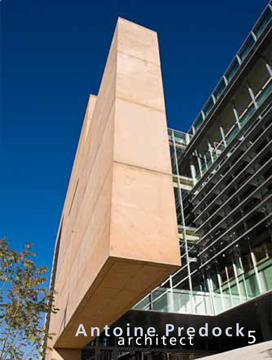
Antoine Predock at the University of New Mexico Art Museum
There are two great new exhibits of Antoine Predock's work at the University of New Mexico. They are well worth seeing. Last night my wife and I were invited to a private recption there. It was great-but not what I expected. This was a special "thank you" reception by Predock and the book's author Christopher Mead to all those who contributed to the new book and exhibit. Predock was very gracious to all of us, mentioning all by name and their contributions. He is a world class talent and a real gentleman. I was honored to be there. The book is his 14th monograth.
ROAD CUT: THE ARCHITECTURE OF ANTOINE PREDOCK
ROAD CUT: THE ARCHITECTURE OF ANTOINE PREDOCK
Wednesday, January 26, 2011
AP thread on LuLa
There is an interesting new thread on Architectural Photography on Luminous Landscape. Many of the usual suspects are contributing. See:
What Kit do you like and why?
What Kit do you like and why?
Tuesday, January 18, 2011
Odd Jobs
"Odd Jobs" refers to jobs that have some unusual aspect to them that I have not encountered before. This is a great example. By and large in AP we avoid seasonal decorations like the plague. Why? Because a)they limit the stock use of the images to seasonally themed publications (i.e. Christmas issue of a shelter magazine); b)this kind of decor is unrelated to the structure or interior design.
This shoot is an exception. The subject IS the Christmas decor. The client was Red Shovel, the designer and installer of the decor and the location is Sandia Casino and Resort in Albuquerque.

The challenges? Making sure the XMAS lights do not blow out rendering them white rather than their intrinsic color. How? No use of HDR, but instead careful timing of the shot paying attention to the depth of the exterior color, use of the 5DII HighLight Priority setting and judicious use of the Recovery slider in Lightroom (or Adobe Camera Raw). Why no HDR? Because of registration issues. I could not control the air handling system so the the long light strands were moving as in a gentle breeze.
This shoot is an exception. The subject IS the Christmas decor. The client was Red Shovel, the designer and installer of the decor and the location is Sandia Casino and Resort in Albuquerque.
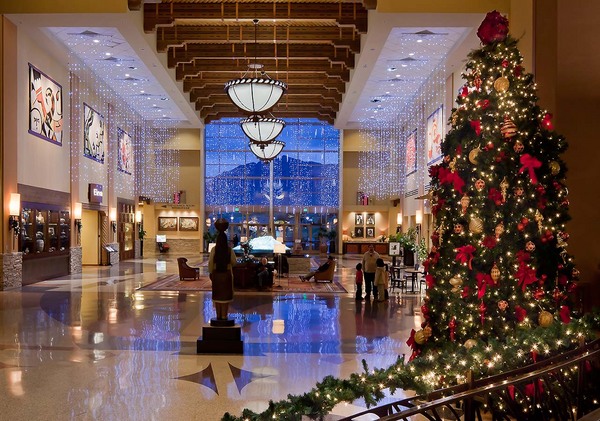
The challenges? Making sure the XMAS lights do not blow out rendering them white rather than their intrinsic color. How? No use of HDR, but instead careful timing of the shot paying attention to the depth of the exterior color, use of the 5DII HighLight Priority setting and judicious use of the Recovery slider in Lightroom (or Adobe Camera Raw). Why no HDR? Because of registration issues. I could not control the air handling system so the the long light strands were moving as in a gentle breeze.
Friday, November 12, 2010
Bill Schwab print offer.....

http://www.billschwab.com/webseries/special_offer/november_2010_offer.html
Tuesday, November 9, 2010
Why Are My Prints Too Dark?
If you print digitally and struggle to get accurate soft-proofing (who doesn't struggle with this?)........this article from LuLa by Andrew Rodney is absolutely fundamental.
Why Are My Prints Too Dark?
Why Are My Prints Too Dark?
AIA Albuquerque Competition
Wow! This year I worked on eight of the fourteen winners entries of the AIA Albuquerque Design Awards. It was very competitive this year with 56 strong entries. Congratulations to all these very talented designers!
Honor Awards
Honor Awards
Casa Guadalupe Franciscan Friary
Architect: Calott + Gifford Architecture / Urban Design
Owner: Province of Our Lady of Guadalupe Franciscan Friars
Contractor: Enterprise Builders
Architect: Calott + Gifford Architecture / Urban Design
Owner: Province of Our Lady of Guadalupe Franciscan Friars
Contractor: Enterprise Builders
Valle Vista Elementary School
Architect: Garrett Smith, Ltd.
Owner: Albuquerque Public Schools
Contractor: Cheyenne Builders
Architect: Garrett Smith, Ltd.
Owner: Albuquerque Public Schools
Contractor: Cheyenne Builders
Merit Awards
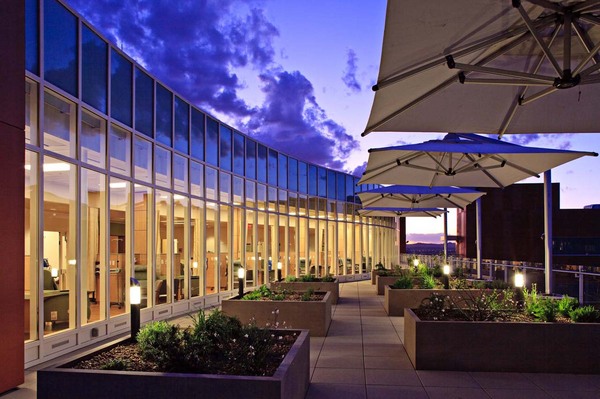
University of New Mexico Cancer Research & Treatment Center II
Architect: Rohde May Keller McNamara Architecture, P.C. & VOA Associates Inc.
Owner: University of New Mexico
Contractor: Flintco Inc. General Contractors
Architect: Rohde May Keller McNamara Architecture, P.C. & VOA Associates Inc.
Owner: University of New Mexico
Contractor: Flintco Inc. General Contractors
Citation Awards
Aperture Center
Architect: Jon Anderson Architecture (Executive)
and Antoine Predock Architect PC (Design)
Owner: Forest City Covington
Contractor: Klinger Constructors, LLC
nex+Gen Academy
Architect: Dekker/Perich/Sabatini
Owner: Albuquerque Public Schools
Contractor: AIC General Contractor
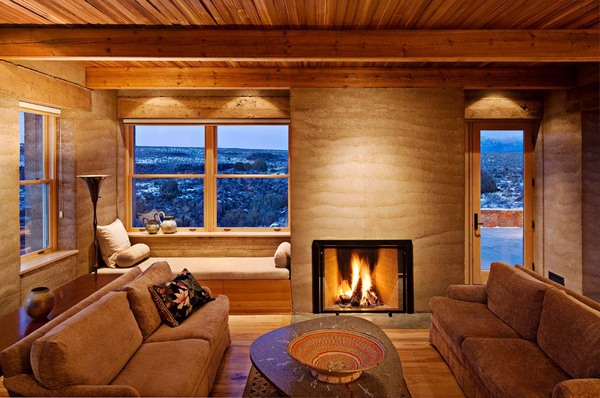
Sage House
Architect: Jon Anderson Architecture (Executive)
and Antoine Predock Architect PC (Design)
Owner: Mike and Vee Yacinno
Contractor: Ian Forsberg - General Contractor
Aperture Center
Architect: Jon Anderson Architecture (Executive)
and Antoine Predock Architect PC (Design)
Owner: Forest City Covington
Contractor: Klinger Constructors, LLC
nex+Gen Academy
Architect: Dekker/Perich/Sabatini
Owner: Albuquerque Public Schools
Contractor: AIC General Contractor
Sage House
Architect: Jon Anderson Architecture (Executive)
and Antoine Predock Architect PC (Design)
Owner: Mike and Vee Yacinno
Contractor: Ian Forsberg - General Contractor
Placita House
Architect: Jon Anderson Architecture
Owner: Juno and Julia Raby
Contractor: Sunbelt Properties - General Contractor
Downtown@700 2nd
Architect: Dekker/Perich/Sabatini
in collaboration with Garrett Smith, Ltd.
Owner: Supportive Housing Coalition of New Mexico
Contractor: Global Structures
Architect: Jon Anderson Architecture
Owner: Juno and Julia Raby
Contractor: Sunbelt Properties - General Contractor
Downtown@700 2nd
Architect: Dekker/Perich/Sabatini
in collaboration with Garrett Smith, Ltd.
Owner: Supportive Housing Coalition of New Mexico
Contractor: Global Structures
Friday, November 5, 2010
Digital Tools for Architectural Photographers
Interesting article by Richard Sexton in LuLa. Richard is a widely published architectural photographer working out of the South. The article is on the tools of the trade. Note the conclusions.
DIGITAL TOOLS FOR ARCHITECTURAL PHOTOGRAPHERS
DIGITAL TOOLS FOR ARCHITECTURAL PHOTOGRAPHERS
Thursday, November 4, 2010
Cropping Architectural Images for Clients
Thanks for the inquirey-good question. First off to maximize image quality, I try to shoot full frame in the field. When I do crop it is to improve image impact and I don't worry really about maintaining the native Aspect Ratio of the camera. So when I deliver a set of files the majority are in the native AR and a few are whatever. Those that are not are mostly stitches of some sort. Clients have never said boo about it. The only time I get a request for a specific AS is with magazine covers or from architects who have existing framed prints in their office that they want to match, but that has been rare."Hello Kirk, I have been reading your site and learning for quite a while. Your eye for images is stunning. I have a question about cropping. I stay within the camera original aspect ratio when I deliver images for clients, unless they provide specifics. I have a start up photography business and I do residential and commercial. I hope to eventually shoot major architectural jobs (I have a longggggg way to go) and am learning all I can. Presently, I'm using a crop sensor Canon DSLR with good results for the clients I have served. I am going full frame with a Canon 5D II set-up in December. What ratio due you normally crop to (hopefully I'm asking the right question here)? Do you stay within your cameras native ratio or do you crop to desired look. I have had several images that I feel would be improved with "free" cropping (no set aspect ratio, just drag box until I get desired effect). Any cropping advice would be appreciated. Much info on cropping, but not much on the delivery side. Keep up the good work"
The only time cropping to a specific AR becomes absolutely critical for me is when I am shooting assigned magazine covers. There has to be room made for the masthead, leads etc. Since all magazines are not the same AS it requires some legwork to figure that out ahead of time. For some of my clients like Su Casa (and), which I have mentioned before here, we always shoot tethered, bring the potential cover up in PS and layer it with the magazines cover template to make sure everything fits. We have learned to do this because of AR issues in the past.
Subscribe to:
Posts (Atom)


 Posts
Posts

